


What Is a Backlink Indexer? A Guide to Backlink Indexing Services
You have built or earned backlinks. The next question is whether search engines actually see them. A backlink that is never crawled or indexed cannot pass authority, traffic, or ranking signals to your site. This is where a backlink indexer comes into the conversation.
In this guide, we explain what a backlink indexer is, how these services claim to work, what the realistic expectations are, and how to check whether your backlinks have been indexed. We also cover the risks, best practices, and alternatives so you can make a safe decision for your SEO strategy.
What Is a Backlink Indexer?
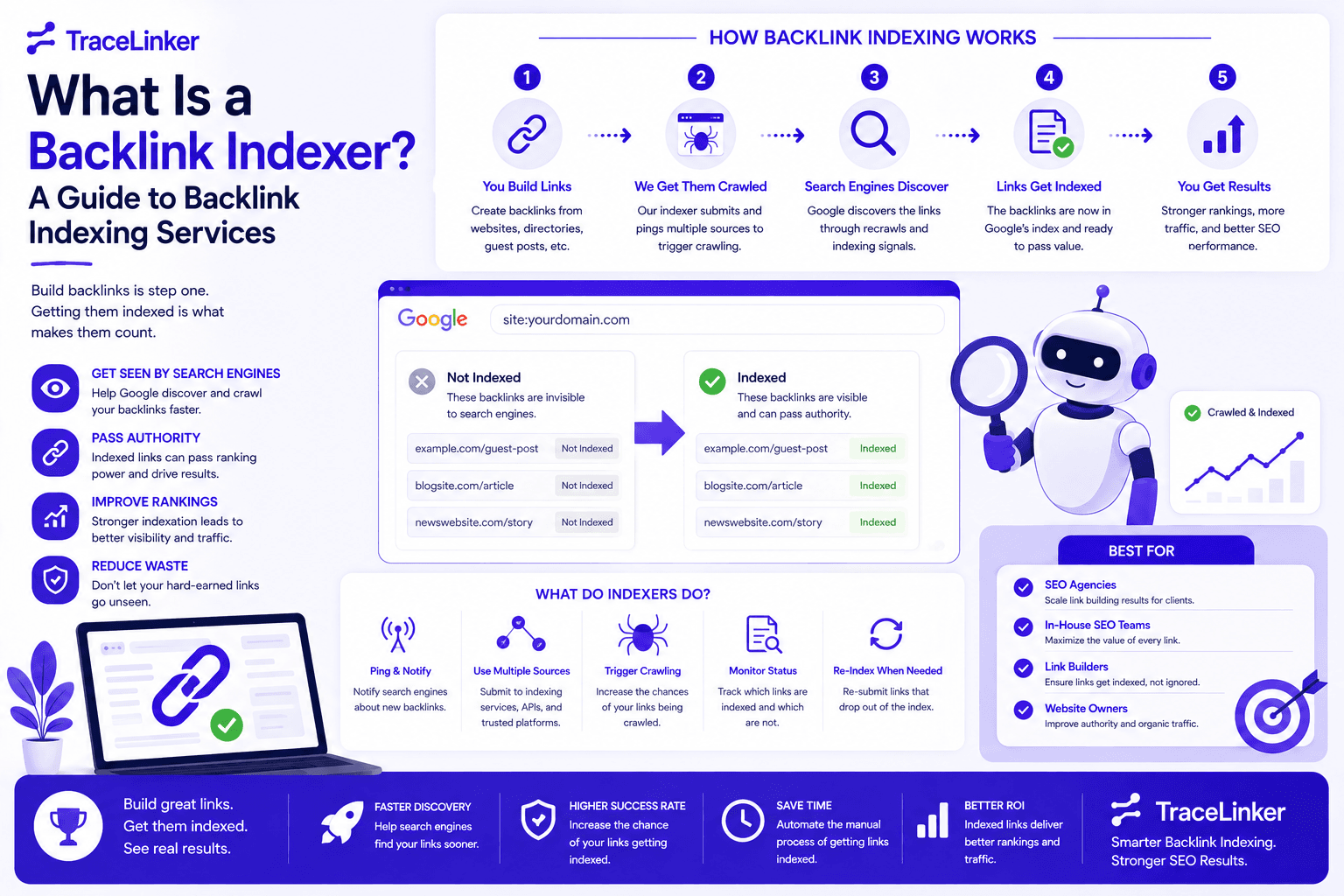
A backlink indexer is a tool or service that submits URLs to search engines in an attempt to speed up crawling and indexing. These services are often marketed to SEO professionals who want faster discovery of the backlinks they have built, especially for pages that are not being picked up naturally.
There are two common forms of backlink indexing tools:
- Standalone indexing services. These accept a list of URLs, usually the pages containing your backlinks, and use various methods to alert search engines or trigger crawler visits. Examples include One Hour Indexing, IndexMeNow, and Indexceptional.
- SEO tool add-ons. Some backlink tools and rank trackers include ping, submission, or indexing features as part of a larger workflow.
The core promise is the same: faster indexing of the pages pointing to your site, so the links can start contributing to your backlink profile sooner.
It is important to separate marketing language from how search engines actually work. Indexing services can encourage crawling by drawing attention to a URL, but only Google and other search engines can decide whether a URL is added to the index. No third-party service can guarantee placement in Google's index.
How Does a Backlink Indexer Work?
Backlink indexers do not directly add pages to a search engine's index. Instead, they try to trigger a crawl by making the URL more visible to search engine bots. The exact methods vary by service, but they usually fall into a few categories.
Crawler Signals and URL Submission
The most common approach is to submit URLs to endpoints that search engines monitor. This can include:
- Pinging services that notify search engines about new or updated URLs.
- RSS feeds or sitemap-style submissions that encourage bots to visit the target page.
- API integrations with third-party services that search engines already crawl frequently.
Indexceptional, for example, describes its process as routing every URL through three distribution channels in parallel and showing a live status pipeline: queued, submitted, delivered, and bot visited. The service records the Googlebot IP address when a visit is detected.
Social and Referral Traffic Signals
Some services generate social signals, referral traffic, or embeds to make a page look more active. The theory is that a page with more activity and referral visits is more likely to be crawled and indexed quickly. The effectiveness of this approach depends heavily on the quality and relevance of the signals.
Link Building to Link Pages
Another method is to build additional links to the pages containing your backlinks. This is sometimes called tiered link building. By creating a second layer of links, the theory is that the original page gets crawled more often because it has more authority pointing to it. This approach carries more risk and is generally discouraged by search engines if the tiered links are low-quality or manipulative.
Manual Verification and Refunds
Some modern services add a verification layer. IndexMeNow checks hourly whether a submitted URL is indexed by Google and promises a refund if the URL is not indexed after a certain period. This is a more honest business model because it ties payment to a measurable outcome rather than to the submission itself.
What the Data Actually Shows
Marketing pages for indexing services often publish impressive numbers. One Hour Indexing shares test results showing indexation rates between 12% and 23% after one hour, and between 37% and 85% after three days, depending on the test batch. IndexMeNow claims an average of 80% of pages indexed within 72 hours and 60% within 24 hours. Indexceptional focuses on bot-visit tracking rather than indexation guarantees.
These numbers are self-reported and should be treated with caution. Real-world results depend on:
- The quality of the backlink page. Low-quality, thin, or duplicate content is less likely to be indexed.
- The authority of the referring domain. Links from established, trusted sites are crawled more often.
- The overall link profile. Natural patterns are more likely to pass algorithmic scrutiny.
- Crawl budget and demand. Search engines allocate crawl resources based on perceived value.
- Search engine algorithm updates. Google has become more selective about what it indexes over time.
In short, a backlink indexer may improve the speed of discovery, but it cannot guarantee the quality of the page or the decision of the search engine.
Do You Need a Backlink Indexer?
The honest answer is: usually not, if your backlinks are high-quality. Google and other search engines are designed to discover and crawl the web without third-party intervention. If your link comes from a real, active website with genuine content, it is very likely to be crawled and indexed naturally.
A backlink indexer becomes more tempting when:
- You are building links at scale and want faster feedback on which pages are indexed.
- The referring pages are new, low-authority, or not part of a frequently crawled site.
- You want to test whether a specific backlink campaign is producing crawlable links.
- You are managing client campaigns and need a reportable metric around indexation.
Even in these cases, an indexer should be treated as a supplementary tool, not a replacement for building good links. The best way to get backlinks indexed is to build backlinks that deserve to be indexed.
Risks of Using Backlink Indexers
Backlink indexing services are not all equal, and some carry real risks.
Quality Control Issues
Low-quality indexers may submit your URLs to spammy networks, private blog networks, or automated bookmarking sites. This can create a toxic footprint around your backlinks and may trigger a manual review or algorithmic penalty. Before using any service, understand exactly where your URLs are being submitted.
Unrealistic Promises
Any service that guarantees 100% indexing or claims to be "Google approved" should be viewed skeptically. Google does not approve third-party indexing services. The search engine decides indexing independently. Services that overpromise can waste budget and create false expectations.
Wasted Crawl Budget
Submitting low-value URLs repeatedly can waste your own crawl budget and signal to search engines that your site produces low-quality pages. This is especially risky for money pages and newer domains that are still establishing trust.
False Sense of Security
Indexation is only one step. A backlink can be indexed and still provide no SEO value if it comes from a spammy, irrelevant, or low-authority site. Focusing too much on indexation can distract from the bigger goal: building a clean, relevant, and authoritative backlink profile.
Best Practices for Backlink Indexing
If you choose to use a backlink indexer, follow these guidelines to minimize risk.
1. Start With High-Quality Links
Only submit backlinks that are genuinely valuable. A link from a real editorial site, industry blog, or news publication is worth indexing. A link from a thin directory or spam page is not.
2. Avoid Mass Indexing of Low-Quality Links
Do not dump hundreds of profile links, comment links, or directory links into an indexer. This pattern looks artificial and can associate your site with low-quality neighborhoods. If you have toxic links, the better move is to disavow them. Our disavow file generator can help you prepare a Google-ready disavow file, and our guide on how to disavow backlinks walks through the process.
3. Use Indexers as a Test, Not a Strategy
Run a small test batch before committing to a larger campaign. Measure whether the service actually increases indexation rates for your specific links and whether you see any ranking or traffic impact. Track results with a backlink CSV analyzer to compare indexed and non-indexed links over time.
4. Monitor Your Backlink Profile
Keep an eye on the links that appear in Google Search Console and third-party tools. Watch for sudden spikes in low-quality links, changes in anchor text distribution, or links from suspicious domains. Our anchor text analyzer can help you review whether your anchor text distribution looks natural.
5. Build Links Worthy of Indexation
The safest and most effective long-term strategy is to earn links that search engines want to index. This means creating original research, useful tools, expert commentary, and content that real people want to reference. Learn more in our guides on link building strategy and how to get website backlinks.
How to Check If Your Backlinks Are Indexed
Before paying for an indexer, confirm whether the backlink is actually missing from the index. There are several ways to check.
Use the Site: Operator
Paste the URL of the page containing your backlink into Google with the site: operator:
site:example.com/page-url
If the page appears in the results, it is indexed. If it does not, the page may not be indexed yet. Note that this operator does not show every indexed URL, but it is a quick first check.
Check Google Search Console
Google Search Console shows the pages and links Google has discovered for your site. While it does not show third-party pages directly, you can use it to confirm whether Google is finding new links to your domain. You can also submit your own new pages for indexing if you want them crawled faster.
Use a Backlink Audit Tool
Export your backlink data from Google Search Console or a CSV export from Ahrefs, Semrush, or similar tools. Then run the CSV through TraceLinker's free backlink checker and backlink CSV analyzer to see which links are present and how they might be influencing your profile.
Check for the Link on the Page
Sometimes a link is indexed but later removed, nofollowed, or hidden. Use our guide on find inbound links to a page to verify that the link still exists and is still dofollow.
Alternatives to Backlink Indexers
If you are not comfortable using an indexer, there are safer ways to encourage search engines to discover and crawl your backlinks.
Internal Linking
Link to your own new or important pages from pages that are already indexed and authoritative. This helps Google discover content through your own site structure. For backlink pages you control, such as guest posts, link to them from your own content or author bio where appropriate.
Social and Email Promotion
Sharing a page on social media, in newsletters, or through email can generate real traffic and engagement. Search engines notice pages that attract genuine human activity. This is a slower but safer signal than automated pings.
Update and Improve Content
If you have earned a backlink from a page that has not been indexed, you can reach out to the site owner and suggest an improvement, update, or additional resource. This adds value to the page and may encourage a fresh crawl. This approach is similar to the broken link building and unlinked mention strategies covered in our guest blogging outreach guide.
Sitemap Submission
For pages you own or manage, submit an XML sitemap through Google Search Console. This is the official way to ask Google to crawl your pages. It does not work for third-party pages, but it is the cleanest method for your own content.
When to Avoid Backlink Indexers Entirely
There are situations where using an indexer is more likely to hurt than help.
- You have a history of link-based penalties. If your site has been hit by Penguin, a manual action, or an algorithmic spam update, avoid any tool that submits links in bulk. Focus on Google penalty recovery and link cleanup first.
- Your backlink profile is mostly low-quality. Indexing spam links faster does not make them valuable. It may make them more visible to Google, which can backfire.
- You are relying on link schemes. If your links come from paid networks, PBNs, or automated tools, no indexer will make them look editorial. Invest in link building strategy instead.
- You do not understand the service's methods. If you cannot find clear information about how the indexer works, assume the risk is high. Transparent services like Indexceptional at least explain that they only trigger crawler visits and do not guarantee indexing.
How TraceLinker Helps You Manage Backlink Indexing
TraceLinker is built to help SEO teams monitor, score, and act on backlinks without relying on risky shortcuts. Whether you are trying to get more links indexed or clean up a messy profile, the platform gives you a clear workflow.
- AI backlink scoring: Every link gets a transparent 1–100 score with a rationale and action items, so you know which links are worth indexing and which should be disavowed.
- Google Search Console and CSV imports: Pull in backlinks from GSC or CSV exports from tools like Ahrefs and Semrush for unified analysis.
- Toxic link detection: Identify PBNs, spam, and suspicious context, then export a Google-ready disavow.txt file.
- Competitor gap analysis: Upload competitor CSVs to see where their indexed links come from and generate outreach pitches.
- Reclaim and outreach emails: AI drafts emails with pre-extracted contact data, so you can turn unlinked mentions or lost links into valuable backlinks faster.
- Monitoring and alerts: Track when links change, go dead, or switch from dofollow to nofollow, so you can respond before rankings drift.
Understanding backlink indexers is useful, but the real advantage comes from monitoring your backlinks continuously and acting on the insights. Start with a free audit using our free backlink checker, then analyze your CSV data with the backlink CSV analyzer to see which links are actually contributing to your profile.
Conclusion
A backlink indexer is a tool that attempts to speed up search engine discovery and crawling of the pages that link to your site. Some services report strong indexation rates, and modern tools even offer refunds for non-indexed URLs. However, no indexer can force Google to include a page in its index. Indexing is a search engine decision that depends on content quality, authority, and crawl demand.
The best approach is to build backlinks that deserve to be indexed, monitor your profile with tools like TraceLinker, and use indexing services only as a careful supplement for high-quality links. If your backlink profile contains toxic or low-quality links, focus on disavow and cleanup rather than trying to index them faster.
If you are ready to take control of your backlinks, run your profile through TraceLinker and turn your link data into a clear action plan.
Related Resources
- Free Backlink Checker
- Backlink CSV Analyzer
- Anchor Text Analyzer
- Disavow File Generator
- Do Follow Backlinks
- What Is Spam Score?
- How to Disavow Backlinks
- Backlink Gap Analysis
- Find Inbound Links to a Page
- Guest Blogging Outreach
- Google Penalty Recovery
- Find Broken Links on a Website
- Link Building Strategy
- Get Website Backlinks