
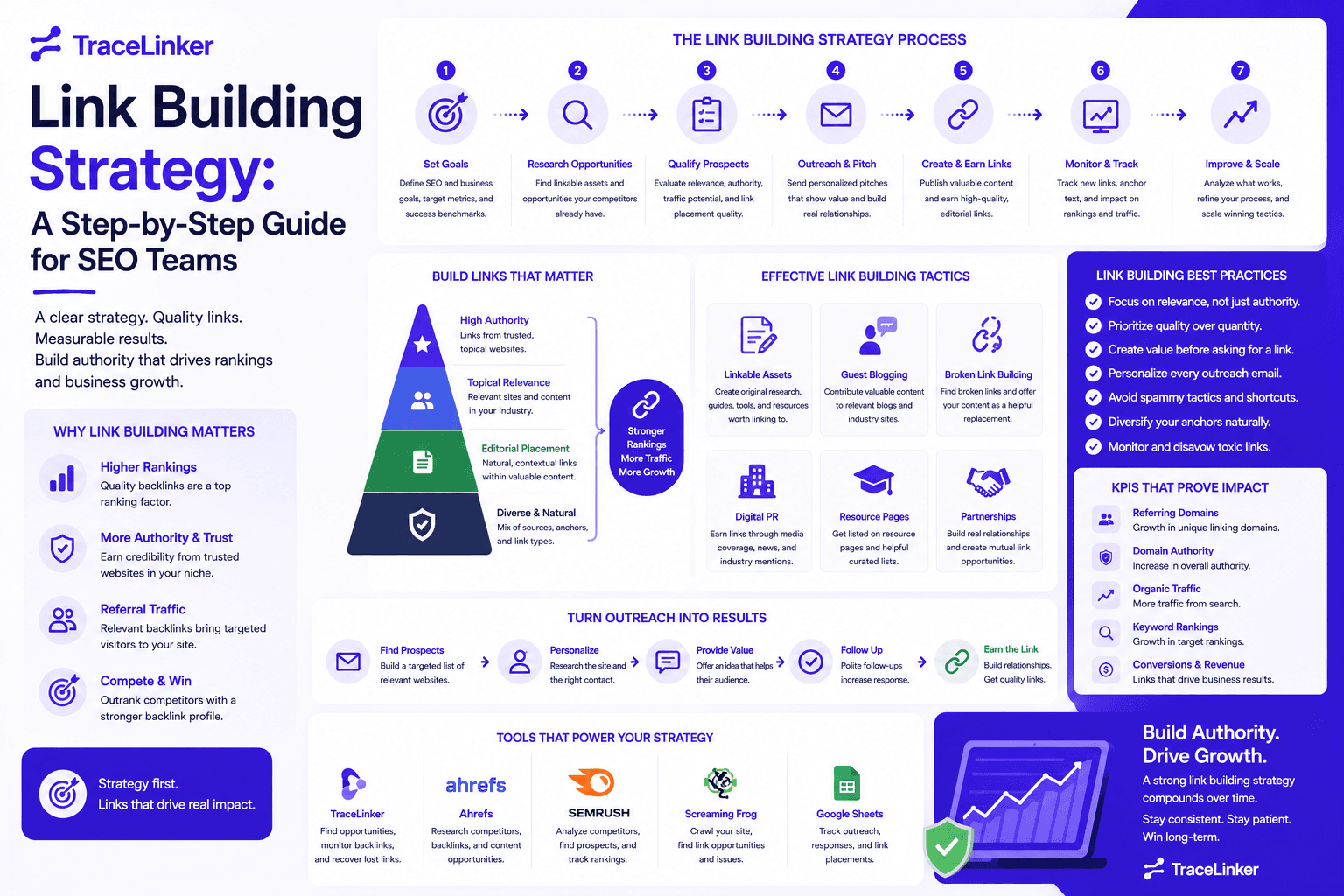


Link Building Strategy: A Step-by-Step Guide for SEO Teams
Link building is one of the most impactful levers in SEO. A single high-quality backlink from a trusted site can move rankings more than hundreds of low-quality links. But link building without a strategy is just guessing. You need a clear plan that ties every link effort to business goals, tracks results, and avoids risks.
At TraceLinker, we help SEO teams build, monitor, and protect their backlink profiles. This guide walks through a practical link building strategy that works for in-house teams, freelancers, and agencies.
What Is a Link Building Strategy?
A link building strategy is a systematic plan to earn backlinks from other websites to your own. It defines:
- What you want to achieve (rankings, authority, traffic, brand visibility)
- Who you want to earn links from
- What content or assets you will use to attract links
- Which tactics you will use
- How you will track and measure success
The best strategies are not just about volume. They focus on earning relevant, authoritative links that improve your site’s trust and visibility over time. Google's algorithms continue to treat links as a strong ranking signal, so a thoughtful strategy remains essential.
Step 1: Set Clear Goals
Before you start prospecting, define what success looks like. Link building can support several business outcomes, but each one changes how you prioritize tactics.
Common goals include:
- Improve rankings for target keywords. Focus on earning links to specific pages that need authority.
- Build domain authority. Aim for a broad set of links from diverse trusted domains.
- Increase referral traffic. Prioritize links from sites with real audiences in your niche.
- Protect brand reputation. Monitor your profile and disavow toxic links before they cause harm.
- Support new content launches. Build a burst of links to fresh pages to accelerate indexing and ranking.
Your goals should be specific and measurable. For example, "earn 20 links from DR 50+ sites to our product pages in the next quarter" is more useful than "get more backlinks."
Step 2: Audit Your Current Backlink Profile
You cannot improve what you do not measure. Start by understanding your current backlinks.
Pull your link data from Google Search Console, Ahrefs, Semrush, or another source. Then analyze:
- Total referring domains and backlinks
- Domain authority or rating distribution
- Anchor text diversity
- Dofollow vs. nofollow ratio
- Toxic or spammy links
- Lost or broken backlinks
- Top linked pages
A healthy profile has links from many different domains, a natural mix of anchor text, a balance of dofollow and nofollow links, and a steady growth pattern. If you see a high concentration of exact-match anchor text, links from unrelated niches, or sudden spikes from low-quality directories, you may need to clean up before building more.
TraceLinker’s free backlink checker gives you a quick view of your current links. For deeper analysis, import a CSV from any third-party tool into the backlink CSV analyzer to score links and flag risks. The anchor text analyzer can show you whether your anchor text distribution looks natural or over-optimized.
Step 3: Analyze Competitor Backlinks
Your competitors have already done part of the work for you. If a site links to your competitor, it may also link to you, especially if you have something better to offer.
Export your competitors' backlink profiles and look for patterns:
- Which domains link to multiple competitors but not to you?
- What types of content earn the most links in your niche?
- Are there common resource pages, roundups, or directories?
- Which journalists or bloggers cover your industry regularly?
- What anchor text do competitors typically receive?
This analysis reveals where your competitors get authority and where your gaps are. It also helps you identify realistic targets. If a site only links to giants in your industry, it may be hard to win. If it links to smaller brands, you have a better chance.
Our backlink gap analysis guide explains how to compare your profile against competitors and prioritize the most valuable opportunities.
Step 4: Choose Your Link Building Tactics
There are many ways to earn backlinks. The best strategy usually combines several tactics based on your goals, resources, and niche.
Content-Based Link Building
Create content that people naturally want to reference. This includes:
- Original research and data studies
- Industry surveys and benchmarks
- Infographics, charts, and visual assets
- Free tools and calculators
- Ultimate guides and in-depth explainers
- Case studies with unique results
Content-based link building is sustainable because great assets keep earning links over time. The downside is that it requires upfront investment in research, design, or development.
Digital PR
Digital PR focuses on earning media coverage and links from journalists, bloggers, and publications. It works best when you have a newsworthy story, original data, or a strong opinion.
Guest Posting
Writing valuable content for other sites in your niche can earn you a contextual link and exposure to a new audience. Focus on quality sites with real audiences, not low-quality networks built only for links. See our guest blogging outreach guide for a practical pitching process.
Resource Page Link Building
Find pages that curate helpful resources on a topic and suggest your content as an addition. This works well when your content fills a clear gap in their list.
Broken Link Building
Find broken links on relevant sites, then offer your content as a replacement. This helps the site owner and earns you a link at the same time. Learn more in our guide on how to find broken links on a website.
Unlinked Brand Mentions
If a site mentions your brand but does not link, reach out and ask for a link. This is one of the easiest wins because the site already knows who you are.
HARO and Expert Contributions
Respond to journalist requests on platforms like HARO, Qwoted, or SourceBottle. Providing a useful quote can earn you a link in an article.
Relationship-Driven Link Building
Building real relationships with journalists, bloggers, and industry peers leads to natural links over time. Comment on their work, share their content, and offer value before asking for anything.
Step 5: Build Linkable Assets
Most link building tactics depend on having something worth linking to. Before you start outreach, make sure you have at least one strong linkable asset.
A linkable asset should be:
- Unique. It offers something that is not easily found elsewhere.
- Credible. Data is sourced, methods are explained, and claims are backed up.
- Useful. It solves a real problem or answers a real question.
- Visual. Charts, images, and clean formatting make it easier to reference.
- Evergreen. It stays relevant long enough to keep earning links.
For example, a backlink study with original data can earn links for years. A free tool can become a go-to resource in your niche. A comprehensive guide can become the definitive reference.
Step 6: Prospect and Prioritize Targets
Not every website is worth pitching. A focused prospect list will save time and improve your success rate.
Use these criteria to prioritize targets:
- Relevance. The site covers topics related to your content.
- Authority. The site has a strong domain rating and organic traffic.
- Linkability. The site has a history of linking to external resources.
- Audience fit. The site’s readers would genuinely benefit from your content.
- Realism. The site is likely to respond to your outreach.
Start with a manageable list. Fifty well-researched prospects are more valuable than five hundred cold emails. Track each prospect, the proposed asset, the contact person, and the outreach status in a simple spreadsheet or CRM.
Step 7: Execute Outreach That Gets Replies
Outreach is where most link building campaigns succeed or fail. The key is to be relevant, concise, and human.
Personalize Every Email
Mention the recipient’s name, reference their work, and explain why your content fits their audience. Generic templates get ignored.
Lead with Value
Explain what the recipient gains by linking to you. Will it help their readers? Fill a gap in their content? Support a claim they made?
Be Specific
Tell them exactly where a link would fit and what page you are suggesting. Do not make them guess.
Follow Up Politely
One follow-up email is usually enough. If they do not respond, move on. Respect their time.
Build Relationships First
The best outreach happens after you have already engaged with the person. Comment on their blog, share their posts, or introduce yourself at events before asking for a link.
TraceLinker’s outreach tools help you draft personalized emails using pre-extracted contact data, making it faster to scale relationship-driven outreach without losing the human touch.
Step 8: Track, Measure, and Iterate
Link building is not a one-time campaign. You need to track results and refine your approach.
Key metrics to monitor:
- New referring domains. The number of unique domains linking to you.
- New backlinks. Total links earned over a period.
- Authority growth. Changes in domain rating or authority scores.
- Ranking movements. Improvements for target keywords.
- Referral traffic. Visits from newly acquired links.
- Link quality. The authority and relevance of linking sites.
- Tactic performance. Which tactics produce the best links at the lowest cost.
Review your results monthly. Double down on what works, drop what does not, and update your prospect list continuously.
Common Link Building Mistakes to Avoid
Buying links. Paid links violate Google’s guidelines and can lead to penalties. The short-term gains are not worth the long-term risk.
Focusing only on quantity. A few high-quality links outperform hundreds of weak ones. Prioritize relevance and authority over volume.
Over-optimized anchor text. Too many exact-match anchors look manipulative. Let publishers choose their own anchor text most of the time.
Ignoring nofollow links. Nofollow links still drive traffic and build brand awareness. They also contribute to a natural link profile.
Building links to weak content. Even the best outreach will fail if the content behind it is not worth linking to. Invest in assets first.
Neglecting toxic links. Bad links can drag your rankings down. Use our disavow file generator to prepare a clean disavow file if you identify harmful links. If you have already been penalized, our google penalty recovery guide walks through the recovery process.
How TraceLinker Supports Your Link Building Strategy
TraceLinker is built for backlink management, which makes it a natural fit for executing and monitoring a link building strategy.
- AI backlink scoring: Every link gets a transparent 1–100 score with a rationale and action items, so you know which links help and which ones hurt.
- Google Search Console and CSV imports: Consolidate backlink data from GSC or CSV exports from tools like Ahrefs and Semrush in one place.
- Competitor gap analysis: Upload competitor CSVs to see where their links come from and generate suggested outreach pitches.
- Toxic link detection: Flag PBNs, spam, and suspicious context, then export a Google-ready disavow.txt file.
- Monitoring and alerts: Track when links change, go dead, or switch from dofollow to nofollow, so you can respond quickly.
- Reclaim and outreach emails: AI drafts personalized emails with pre-extracted contact data, so you can turn mentions and lost links into backlinks faster.
A strong link building strategy starts with understanding your current profile. Run a quick audit with our free backlink checker, then dig deeper with the backlink CSV analyzer to build a data-driven plan.
Conclusion
A successful link building strategy is not about tricks or shortcuts. It is about creating real value, building relationships, and earning links from authoritative, relevant sites. By setting clear goals, auditing your profile, analyzing competitors, choosing the right tactics, and tracking results, you can build a sustainable flow of backlinks that improves your rankings and authority over time.
Start with a foundation of great content and a clean backlink profile. Then use tools like TraceLinker to monitor your progress, identify opportunities, and act on them before your competitors do.