
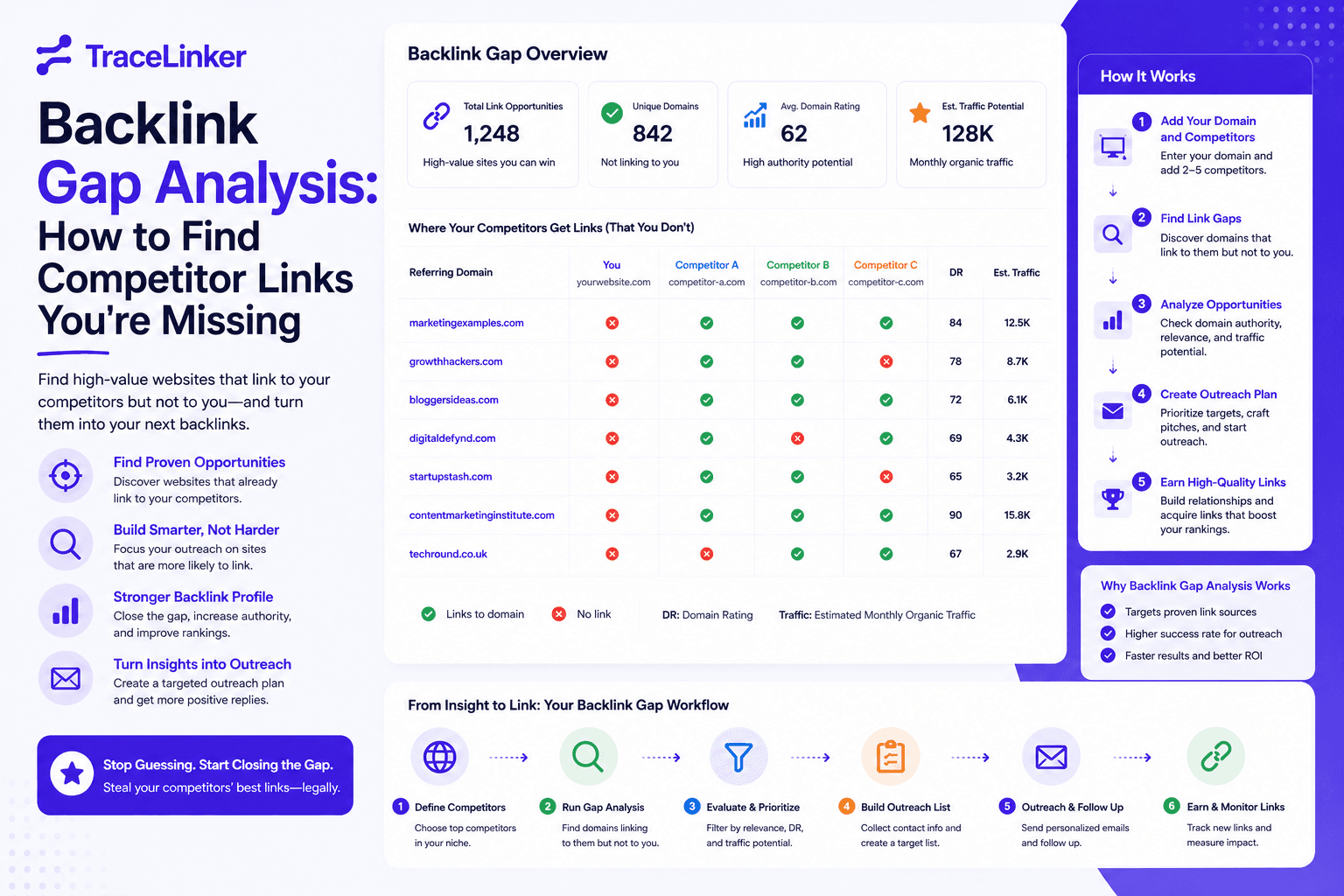


Backlink Gap Analysis: How to Find Competitor Links You're Missing
Link building is hard. Cold outreach to random sites rarely works. The smarter approach is to find websites that already link to your competitors and ask them to link to you too. That is what backlink gap analysis does.
Instead of guessing where to build links, a backlink gap analysis shows you proven opportunities. This guide explains how to run one and turn the results into a targeted outreach plan.
What is backlink gap analysis?
Backlink gap analysis is the process of comparing your backlink profile against your competitors’ profiles to find linking opportunities. Specifically, you look for websites that link to one or more competitors but not to you.
These sites are valuable because they have already shown interest in your topic or industry. If they linked to a competitor, they are more likely to link to you — especially if your content or tool is better.
Why backlink gap analysis matters
A backlink gap analysis helps you:
- Find proven link opportunities instead of guessing.
- Understand competitor strategy by seeing where they earn links.
- Prioritize outreach to sites most likely to respond.
- Identify content gaps by seeing what earns links in your niche.
- Close the authority gap between you and top competitors.
If your competitors outrank you, links are often a major reason. A gap analysis gives you a roadmap to catch up.
Step 1: Identify your real competitors
Before analyzing links, choose the right competitors. Your business competitors may not be your SEO competitors.
Look for sites that:
- Rank for the same keywords you target.
- Have a similar audience and offering.
- Are close to your level of authority, not giants like Amazon or Wikipedia.
- Have a backlink profile you can realistically compete with.
Aim for 3–5 competitors. Too few misses opportunities; too many creates noise.
Step 2: Export backlink data
Use a backlink checker to export the inbound links for each competitor. Most tools let you export referring domains or full backlink lists. Useful tools include:
- Ahrefs: Site Explorer and Link Intersect
- Moz: Link Explorer and Link Intersect
- Semrush: Backlink Gap and Backlink Analytics
- SE Ranking: Backlink Gap Analyzer
- Majestic: Site Explorer
The export should include at minimum:
- Referring domain
- Source URL
- Target URL on the competitor’s site
- Anchor text
- Domain authority or rating
- Link type (dofollow/nofollow)
Step 3: Combine and compare profiles
Load the exports into a spreadsheet or analysis tool. Create a list of all unique referring domains. Then mark which domains link to:
- You only
- Competitor only
- Both you and competitors
The domains that link to competitors but not to you are your backlink gaps. These are your primary outreach targets.
For a faster workflow, upload your CSV exports to TraceLinker’s backlink CSV analyzer. It classifies links, scores quality, and helps you compare multiple competitor profiles in one place.
Step 4: Evaluate link quality
Not every gap is worth pursuing. Evaluate each opportunity before outreach.
| Factor | What to check |
|---|---|
| Relevance | Does the site cover your topic or industry? |
| Authority | Does the domain have strong authority and traffic? |
| Link context | Is the link in a relevant article or directory? |
| Dofollow ratio | Is the link followed or nofollowed? |
| Anchor text | Is the anchor natural or over-optimized? |
| Site health | Does the site look legitimate, or spammy? |
| Recency | Is the link recent and active? |
Filter out low-quality sites, link farms, and PBNs. A few high-quality links are worth more than hundreds of weak ones.
Step 5: Understand why the link exists
Visit the source pages linking to your competitors. Try to understand how the link was earned. Common patterns include:
- Guest posts: the competitor wrote an article for the site.
- Listicles: the competitor is featured in a roundup of tools or resources.
- Directories: the competitor is listed in a niche directory.
- Reviews: the site reviewed the competitor.
- Resource pages: the competitor’s content is linked as a useful resource.
- Partnerships: the competitor has a business relationship with the site.
- Press mentions: the competitor was featured in news or PR.
Each pattern requires a different outreach approach. A guest post site needs a pitch. A listicle needs an inclusion request. A resource page needs a better resource.
Step 6: Prioritize outreach targets
Rank your opportunities by effort and expected value. A simple matrix:
| Priority | Profile |
|---|---|
| High | High authority, relevant, links to multiple competitors, easy to replicate |
| Medium | Relevant, moderate authority, single competitor link, clear link pattern |
| Low | Low authority, unclear relevance, hard to replicate, or spammy-looking |
Start with high-priority targets. They offer the best return on outreach effort.
Step 7: Plan your outreach
For each target, decide on the angle before you email. Generic “please link to me” messages fail. Better approaches:
- Listicle inclusion: “I noticed your post on [topic] features [competitor]. We have a [tool/resource] that might be a good fit too.”
- Guest post: “I’d love to contribute an article on [topic] that would be useful to your audience.”
- Resource page: “Your resources page on [topic] is excellent. We recently published a more comprehensive guide that might be worth adding.”
- Broken link building: “I found a broken link on your page. We have a working resource that could replace it.”
- Linkable asset: “We created a free [tool/template/dataset] that your readers might find useful.”
Personalize every email. Mention the specific page, why it is relevant, and what value you offer.
How to do backlink gap analysis at the page level
Domain-level gap analysis is broad. Page-level analysis is more precise. Instead of comparing entire sites, compare a specific page on your site to the top-ranking pages for that keyword.
- Identify a page you want to rank better.
- Find the top 3–5 ranking pages for the target keyword.
- Export the backlinks to those competitor pages.
- Find pages linking to competitors but not to yours.
- Reach out with a relevant reason to link to your page.
This is especially useful for competitive keywords where a few extra quality links can move the needle.
Tools for backlink gap analysis
| Tool | Key feature |
|---|---|
| Ahrefs | Link Intersect for domain and page-level gaps |
| Moz | Link Intersect with authority scores |
| Semrush | Backlink Gap with multiple competitor inputs |
| SE Ranking | Backlink Gap Analyzer with Domain Trust |
| TraceLinker | CSV import, transparent link scoring, outreach exports |
TraceLinker is particularly useful if you want to analyze backlink CSVs from multiple sources, score links with transparent AI reasoning, and monitor new or lost competitor links over time.
How to use TraceLinker for backlink gap analysis
TraceLinker supports a focused gap analysis workflow:
- Export competitor links: download CSVs from Ahrefs, Semrush, Moz, or GSC for each competitor.
- Upload to CSV analyzer: use the backlink CSV analyzer to clean and classify the data.
- Compare domains: identify which domains link to competitors but not to you.
- Score opportunities: each link gets a 1–100 score with a rationale, so you can prioritize high-value targets.
- Monitor changes: set up re-crawls to detect when competitors gain new links.
- Prepare outreach: export the filtered list and use the contact data and AI-drafted email suggestions to start outreach.
For quick checks, the free backlink checker gives you a snapshot of any domain or page’s inbound links.
Common backlink gap analysis mistakes
- Targeting every gap: not every competitor link is worth replicating. Focus on quality and relevance.
- Ignoring link context: a link in a listicle is easier to replicate than a link from a business partner.
- Copying exact anchor text: use natural, varied anchors. Over-optimized anchors can trigger penalties.
- Forgetting your own profile: analyze your own links first so you know what you already have.
- Skipping follow-up: outreach rarely succeeds on the first email. Plan 2–3 follow-ups.
- Neglecting spam checks: some competitor links are toxic. Do not try to replicate them.
For help identifying toxic links, see our guide on how to reduce spam score and use the anchor text analyzer to spot unnatural patterns.
How often should you run a backlink gap analysis?
Run a full gap analysis quarterly. Also run a focused page-level analysis when:
- You launch a new product or content asset.
- A competitor page starts outranking you.
- You are preparing a link-building campaign.
- You notice a drop in rankings for a priority keyword.
Between full analyses, monitor new and lost competitor links monthly. This keeps you aware of their current strategy and lets you react quickly.
Final thoughts
Backlink gap analysis turns link building from guesswork into a targeted process. By finding sites that already link to competitors, you focus outreach on proven opportunities. The key is to not just copy competitors, but to understand why each link exists and offer something better.
Start with a small set of competitors, export their links, evaluate quality, and prioritize outreach. If you want a faster, more transparent way to run the analysis, use TraceLinker’s backlink CSV analyzer and free backlink checker to turn data into action.