
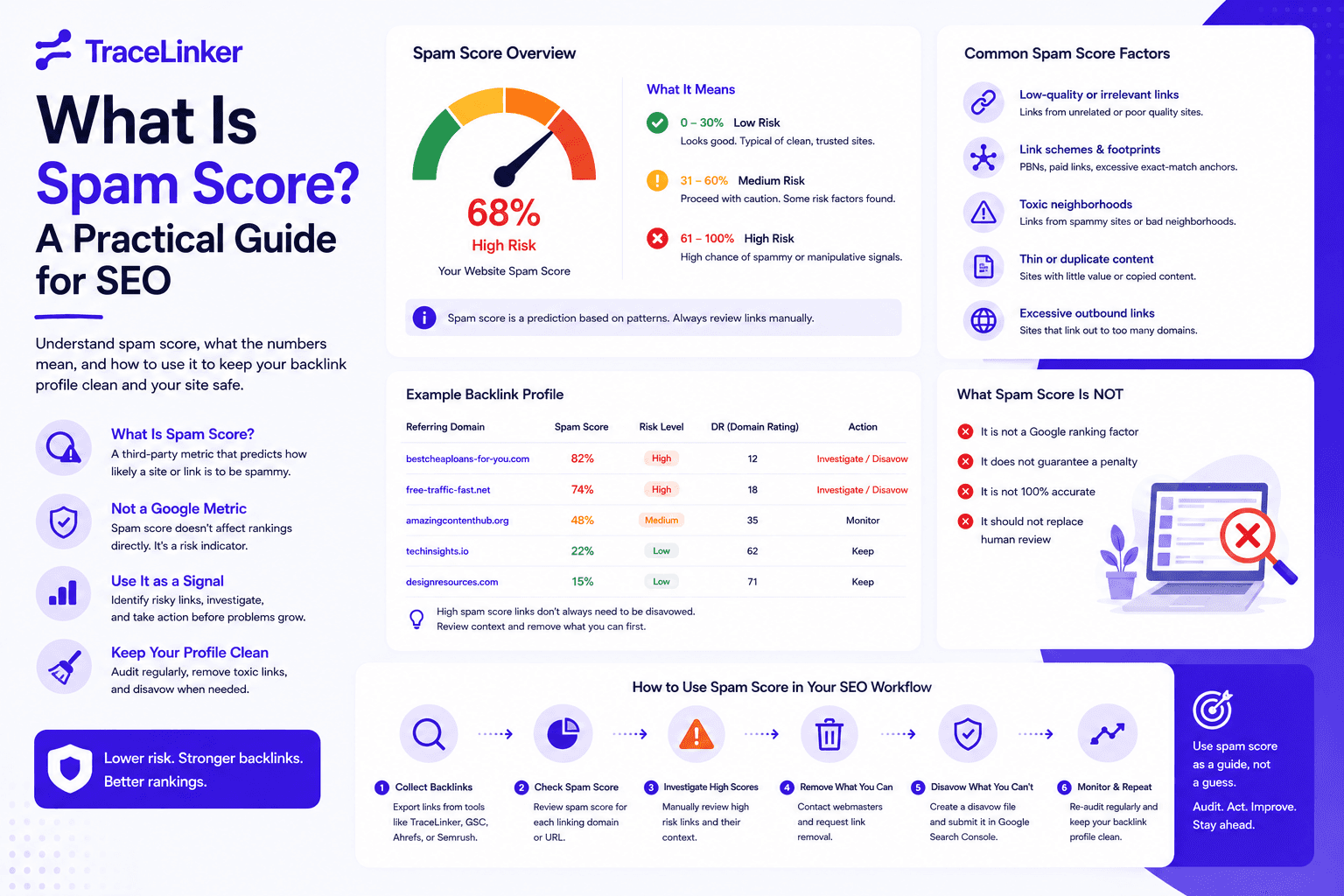


What Is Spam Score? A Practical Guide for SEO
Spam score is a third-party metric that estimates how likely a website or backlink is to be associated with spammy or manipulative practices. It is not a Google metric, and it does not directly affect your rankings. Instead, it is a signal you can use to evaluate the quality of your backlink profile and decide which links deserve a closer look.
Tools like Moz, Semrush, and TraceLinker use spam score to flag backlinks that share patterns with sites that have been penalized by Google. A high score does not mean a link is definitely harmful. It means the link has characteristics that correlate with penalties, so you should investigate before acting.
This guide explains how spam score works, what the numbers mean, and how to use it as part of a backlink audit.
What spam score actually measures
Spam score is built on machine learning. Moz trained its model on millions of sites that were penalized or banned by Google, then identified patterns that those sites had in common. The result is a set of signals that, when present, suggest a site is more likely to be spam.
Moz uses 27 signals. Other tools may use different sets, but the idea is the same: compare a site or link against patterns that historically appear on penalized sites.
It is important to remember that spam score is about correlation, not causation. A site can trigger many spam signals and still be legitimate. The score is a starting point for investigation, not a verdict.
The 27 Moz spam score signals
The Moz signals fall into four broad categories: trust signals, on-site signals, domain signals, and link signals. Not every signal is equally important, and Moz does not publish the exact weight of each one.
Trust signals
These are the features that legitimate businesses tend to have and spam sites often lack:
- Phone number present on the site
- Email address present on the site
- Link to a LinkedIn page
- Facebook Pixel present
- Google Tag Manager present
- DoubleClick ad tag present
- HTTPS enabled by default
- Favicon in use
- Google Font API in use
If a site is missing several of these, it may look more like the spam sites in the training data.
On-site content signals
These look at basic page quality and structure:
- Very long or very short title tags
- Very long or very short meta descriptions
- Meta keywords tag present
- Very long meta keywords tag
- Presence of poison words in the content
- Low number of pages found by crawlers
- Very high or low ratio of external links to content
These signals are easy to manipulate, so they should not be judged in isolation. A small, simple site can naturally have a short title and a low page count without being spam.
Domain signals
These look at the domain itself:
- Domain name length similar to spam sites
- Numerals in the domain name
- Multiple hyphens in the domain name
- Sequential vowels or consonants in the domain name
- URL path length that is unusually short or long
- Top-level domain correlated with spam, such as .download, .stream, .win, or .biz
A domain with numbers and hyphens is not automatically bad, but these patterns are more common in low-quality sites.
Link signals
These look at linking behavior:
- Abnormally high or low number of external outlinks
- Abnormally high or low number of domains linked to
- High CPC anchor text in outlinks
- Unusually high or low number of inbound links
The link-based signals are often the most useful for backlink audits, because they help you spot links that look unnatural.
How to read spam score ranges
Moz reports spam score as a percentage from 1% to 100%. The percentage represents the share of sites with similar features that Moz found to be penalized or banned by Google.
| Score range | Interpretation |
|---|---|
| 1% – 30% | Low spam score. The site looks relatively normal, but review the backlink profile if you see other red flags. |
| 31% – 60% | Medium spam score. The site shares more patterns with penalized sites. Worth investigating, especially for backlinks. |
| 61% – 100% | High spam score. The site has many spam-like features. Treat it as a warning and dig deeper before linking or keeping the link. |
A high score does not mean you should immediately disavow. It means you should look at the site's content, relevance, traffic, and overall link profile. Many good sites can trigger a few spam signals by accident.
Spam score and your backlink profile
There are two ways to use spam score in link building and monitoring:
Your own site's spam score. This estimates how similar your domain looks to penalized sites. If your score is high, audit your backlink profile and site quality. Look for low-quality links, thin content, or technical issues that match spam signals.
The spam score of sites linking to you. This is usually more actionable. If a site linking to you has a high spam score, it may be a low-quality or manipulative link. You can use the score to prioritize which links to review first.
Spam score is most useful when you combine it with other metrics. A high spam score plus low traffic, irrelevant content, and exact-match anchor text is a much stronger warning sign than a high spam score alone.
Spam score vs. a Google penalty
A spam score is not the same as a Google penalty. Google does not publish a spam score, and its algorithms evaluate links differently than Moz or any other tool.
Google's systems are generally good at ignoring low-quality links automatically. You only need to disavow links if you have a manual action for unnatural links, or if you have participated in link schemes that violate Google's guidelines.
If you are unsure whether to disavow, read our guide on how to disavow backlinks. It covers the decision process and the correct file format.
How to check spam score
Most SEO tools that include backlink data also show a spam or toxicity score:
- Moz shows Spam Score in Link Explorer and Moz Pro Campaigns.
- Semrush shows Toxicity Score in its Backlink Audit tool.
- TraceLinker scores every link from 1 to 100 with AI-generated reasoning and flags toxic patterns.
You can also check your backlink profile with TraceLinker's free backlink checker or import a CSV from Ahrefs, Semrush, or Moz into the backlink CSV analyzer. The analyzer classifies links and highlights patterns that match common spam signals.
If you want to understand the anchor text distribution behind your links, use the anchor text analyzer. Over-optimized anchor text is one of the most common spam patterns that appears in manual actions.
What to do if your spam score is high
If you or your backlinks have a high spam score, follow these steps before making any changes:
1. Confirm the score with more than one source
Different tools use different models. A high score in one tool and a low score in another often means the link is borderline. Use multiple signals to decide.
2. Visit the linking site manually
Open the URL and look at the content. Is it relevant to your niche? Does it have real authors, contact information, and a genuine audience? If the site looks abandoned, generic, or full of ads, it is probably low quality.
3. Check the anchor text
Exact-match or high-CPC anchor text is a stronger negative signal than a high spam score. Use the anchor text analyzer to see whether your links are over-optimized.
4. Decide whether to remove, disavow, or keep the link
If the link is clearly manipulative, irrelevant, or from a PBN, add it to your disavow list. If it is from a legitimate site with a few spam signals, leave it alone. Google usually ignores harmless low-quality links.
5. Build more high-quality links
The best long-term defense against a high spam score is a healthy backlink profile. Earn links from trusted, relevant sites, and the relative impact of any single bad link will shrink.
For a step-by-step cleanup plan, see our article on how to reduce spam score of a website.
Common mistakes when using spam score
- Treating it as a Google metric. Spam score is a third-party estimate. Google does not use it.
- Disavowing every link with a high score. This can remove links that are not actually harmful. Disavow only when you have clear evidence of manipulation.
- Ignoring context. A high score on a single relevant, trusted site is less concerning than a high score on an unknown directory.
- Focusing only on your own score. The spam score of sites linking to you is often more important than your own domain's score.
- Panicking over a low score. A low or medium score is normal for many sites. You do not need to chase a zero score.
How TraceLinker uses spam score in practice
TraceLinker approaches link quality with transparent AI scoring rather than a black-box spam percentage. Every link gets a score from 1 to 100, along with a one-sentence rationale and 3 to 5 suggested actions.
This makes it easier to decide what to do next:
- Toxic links are flagged for disavow or removal.
- Borderline links are queued for manual review.
- High-quality links are monitored for changes or loss.
TraceLinker also imports CSV exports from Moz, Ahrefs, and Semrush, so you can cross-reference spam scores with your own link data. If you decide to disavow, the disavow file generator produces a Google-ready disavow.txt file.
FAQ
Is a high spam score always bad? No. It means the site shares patterns with penalized sites. You should investigate, but not panic.
Can spam score cause a Google penalty? No. Google does not use Moz's spam score. Penalties come from Google's own evaluation of your links and content.
How often should I check spam score? Check it during regular backlink audits and when you acquire new links. Monitoring tools can alert you when new links appear with suspicious patterns.
Can I reduce spam score quickly? Disavowing links can remove them from your profile, but building a stronger overall profile is the most reliable long-term strategy.
What is the difference between spam score and toxicity score? Spam score is Moz's term. Toxicity score is Semrush's term. Both estimate link risk, but they use different signals and weightings.
Final thoughts
Spam score is a useful diagnostic tool, not a decision tool. It helps you find links that need investigation, but the final call should be based on relevance, quality, and whether the link looks earned or manipulative.
Use it alongside traffic data, anchor text analysis, and your own judgment. If you keep a clean, relevant backlink profile, a few high-spam-score links will rarely cause problems. And if you ever need to clean up your profile, TraceLinker's monitoring, scoring, and disavow tools can guide you through the process.
Start by checking your current links with the free backlink checker, or upload a CSV to the backlink CSV analyzer to see which links are worth your attention.