
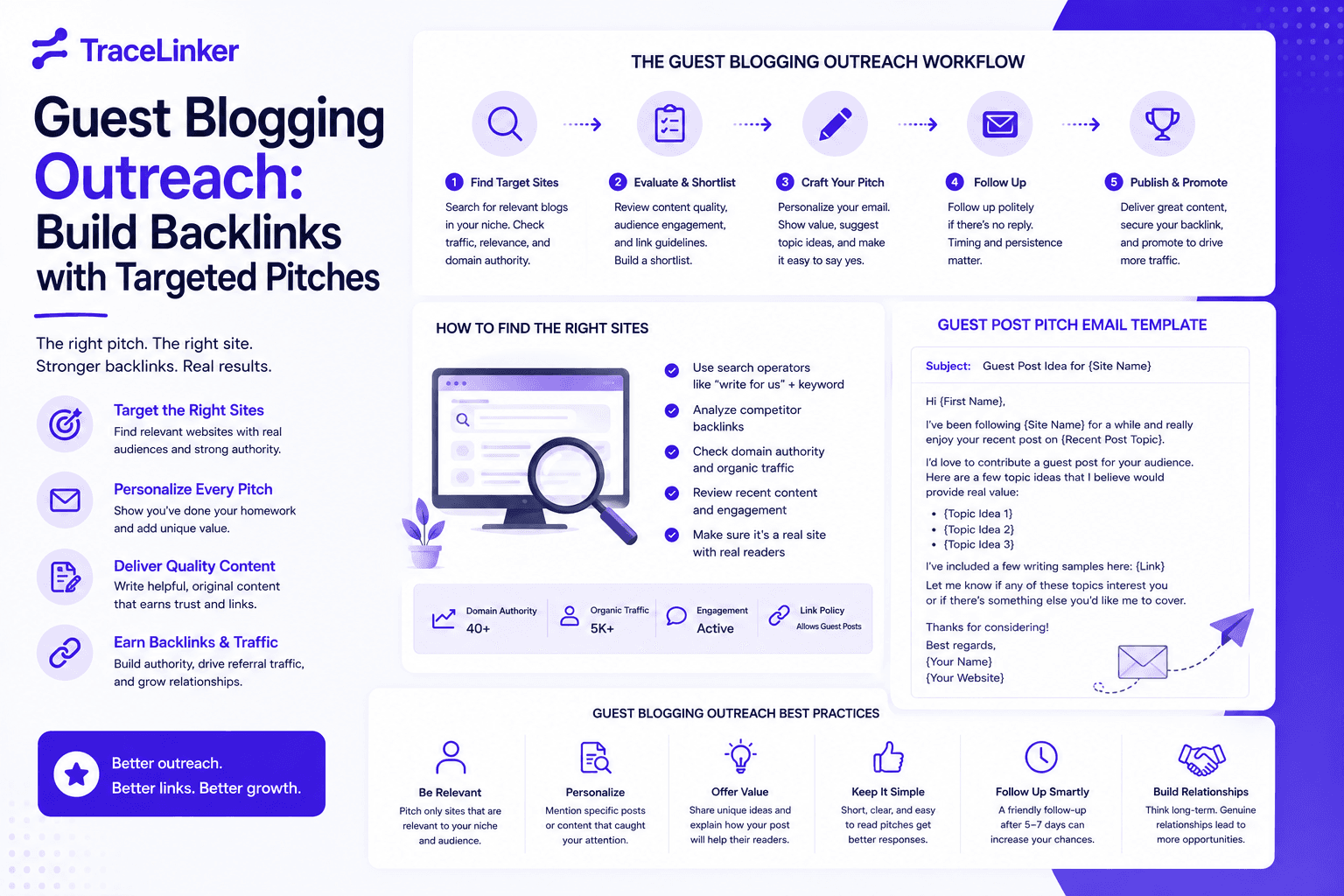


Guest Blogging Outreach: Build Backlinks with Targeted Pitches
Guest blogging outreach is one of the few link-building tactics that can deliver authority, referral traffic, and industry relationships at the same time. When done well, a single guest post can send qualified visitors to your site, improve your backlink profile, and introduce your brand to a new audience.
When done poorly, it becomes another form of spam. Most website owners receive dozens of templated guest post pitches every week. The emails that win are the ones that prove the sender has actually read the site, understands the audience, and is offering something useful.
This guide is a practical, manual workflow for guest blogging outreach. It is written for SEO teams, agency link builders, and founders who want to earn links without relying on low-quality networks or paid placements.
Why guest blogging outreach still works
Search engines have become better at ignoring manipulative links, but editorial links from relevant sites still carry weight. A guest post on a trusted site sends strong relevance and authority signals. It also supports E-E-A-T: your content appears on a site Google already trusts, and readers associate your brand with expertise.
The benefits are not limited to SEO:
- Referral traffic: a well-placed guest post can send consistent traffic for years.
- Brand awareness: readers discover your brand in a context where it is already endorsed by a publisher.
- Relationships: good outreach creates long-term partnerships, not one-off links.
- Content reuse: guest posts often become case studies, social content, or internal training material.
The key is that the link must be earned. If your only goal is to drop an exact-match anchor in a low-quality article, you are better off doing nothing. Poor guest blogging can lead to manual actions, algorithmic filtering, and a backlink profile that needs cleanup later.
A five-step guest blogging outreach workflow
1. Define your audience and topic angle
Before you search for sites, decide who you are trying to reach and what you can teach them. A guest post should not be a sales page. It should solve a problem for the publisher’s audience.
Ask yourself:
- What pain points does this audience share?
- What unique experience or data do you have?
- What would a reader bookmark, share, or act on?
- Which topics naturally lead to your product or service as a resource?
Your topic should fit the host site’s content catalog. If you are pitching a marketing blog, “How to reduce spam score after a link cleanup” is a stronger angle than “Why our tool is the best.”
2. Build a list of reputable sites
Prospecting is where most campaigns fail. A list of 30 relevant, vetted sites will outperform a list of 300 scraped URLs.
Use Google search operators to find sites that accept guest posts:
your keyword “write for us”your keyword “guest post”your keyword “guest post guidelines”your keyword “become a contributor”your keyword “submit an article”
For each site, check:
- Relevance: does the site publish content in your niche?
- Authority: look at Domain Rating, Domain Authority, or organic traffic. High DA alone is not enough.
- Traffic: does the site actually rank for keywords? Use any search analytics tool or public estimates.
- Outbound links: are existing guest posts linking to reputable sites, or are they filled with irrelevant links?
- Engagement: do posts have comments, shares, or evidence of a real audience?
- Publishing frequency: a site that has not posted in months may be abandoned.
Keep a spreadsheet with columns for site, contact page, editor name, guidelines URL, domain metrics, and status. You can also import link data into TraceLinker’s backlink CSV analyzer to score prospects the same way you score your own backlink profile.
3. Write a personalized pitch
Your pitch is not the place for flattery. It is the place to prove you belong on the site.
A strong guest post pitch has five parts:
- A specific subject line: mention the proposed topic or a recent post. Avoid “Guest post opportunity” or “Quick question.”
- Proof of familiarity: reference a recent article and explain why your topic complements it.
- Credibility: share one or two relevant examples of your writing, not a list of unrelated links.
- Proposed topics: offer two or three headline ideas. One should be clearly timely, one should be evergreen, and one should be a fresh angle on a high-traffic post.
- A clear call to action: ask whether any of the topics fit their editorial calendar.
Example opening:
Hi [Name],
I read your recent post on [topic] and appreciated the section on [specific detail]. It lines up with a case study we ran on [related topic], and I think a follow-up article on [proposed angle] would resonate with your readers.
Here are a few ideas:
- [Headline option 1]
- [Headline option 2]
- [Headline option 3]
I have written for [site 1] and [site 2] on similar topics. Happy to adjust the angle if something else fits your calendar.
Best, [Your name]
Personalization takes more time, but response rates are dramatically higher. If you cannot write something specific about the site, remove it from your list.
4. Deliver the content and the link
Once a site accepts your pitch, follow the guidelines exactly. Most editors reject articles because the writer ignored word count, formatting, or link rules.
Best practices for the article itself:
- Match the host site’s tone and formatting.
- Include original examples, data, or screenshots.
- Link to authoritative sources, not just your own site.
- Use natural anchor text. Avoid exact-match keyword anchors.
- Add a short, useful author bio with one link.
The link to your site should feel like a natural reference. If the article works without it, the placement is probably weak. If the article is genuinely useful, one relevant link is more valuable than three forced ones.
After publishing, track the URL in your backlink monitor. TraceLinker’s free backlink checker can help you confirm that the link is live and indexable.
5. Follow up and measure
Website owners are busy. A polite follow-up can rescue a pitch that was lost in an inbox. Wait five to seven business days, then send a short, value-focused follow-up.
A reasonable follow-up sequence:
- Day 0: initial pitch.
- Day 7: short follow-up with a new headline idea or relevant reference.
- Day 14: final check. If no response, move the site to a “nurture” list and engage with their content over the next few months.
Do not send more than three emails. Aggressive follow-ups burn relationships and can get your domain marked as spam.
Track these metrics to improve your campaign:
- Reply rate: how many editors responded.
- Placement rate: how many pitches became published posts.
- Referral traffic: visits from the guest post to your site.
- New referring domains: growth in your backlink profile.
- Anchor text distribution: are your guest post links using branded, natural, or over-optimized anchors?
Use TraceLinker’s anchor text analyzer to check whether your guest post links are creating a balanced profile or over-optimizing one keyword.
Common guest blogging outreach mistakes
Even experienced link builders make these mistakes. Avoid them from the start:
- Mass-blasting templates: editors can spot a template in seconds. If you cannot personalize, do not send.
- Ignoring submission guidelines: guidelines exist because editors are tired of fixing the same errors. Read them.
- Over-optimized anchor text: exact-match anchors in guest posts are a red flag. Use branded, natural, or URL anchors.
- Targeting low-quality networks: PBNs and guest post farms can cause more harm than good.
- Forgetting the follow-up: many placements are lost because the sender gave up after one email.
- No tracking: if you do not track placements, you cannot measure ROI or protect your link profile.
If you inherit a profile with spammy guest post links, you may need to remove them or create a disavow file. TraceLinker’s disavow file generator produces a Google-ready disavow.txt from your list of toxic URLs. You can also read our guide on how to disavow backlinks for the full process.
Tools that support guest blogging outreach
Guest blogging outreach is a manual process, but the right tools make it faster and more accurate.
| Tool | What it helps with | When to use it |
|---|---|---|
| Spreadsheet or CRM | Prospect tracking, status, notes | For every campaign |
| Hunter / Apollo.io | Finding editor email addresses | Once you have a target site |
| Google Search + operators | Discovering guest post opportunities | Early prospecting |
| Backlink checker | Verifying live links and authority | After placement and ongoing |
| Backlink CSV analyzer | Scoring prospect lists in bulk | When vetting large lists |
| Outreach email generator | Drafting initial pitch templates | When scaling personalized outreach |
| Anchor text analyzer | Monitoring link text diversity | Ongoing profile health |
| Disavow file generator | Cleaning up toxic links | If low-quality placements accumulate |
TraceLinker’s focus is on the link-quality side of the workflow: monitoring live links, scoring backlink health, and cleaning up toxic links. For the outreach itself, we recommend pairing TraceLinker with a lightweight email finder and a strict prospecting process.
How to scale without becoming spam
Scaling guest blogging outreach does not mean sending more templates. It means systematizing the research so you can personalize at a higher volume.
Tips for scaling responsibly:
- Batch research: spend one day building a list, then spend the next day writing pitches.
- Use snippets, not templates: keep a library of opening lines, proof points, and topic ideas that you can combine for each prospect.
- Set quality thresholds: only pitch sites above a minimum authority or traffic threshold.
- Limit sends per day: high-volume outreach can trigger spam filters. Keep your daily sends low and consistent.
- Track everything: record pitch date, reply date, publish date, and URL so you can report real ROI.
If you want to compare your guest post links against competitors, use backlink gap analysis to find domains linking to them but not to you. Then turn those domains into a targeted outreach list.
When to avoid guest blogging outreach
Guest blogging is not right for every site. You should pause if:
- Your website is brand new and has no existing content to demonstrate expertise.
- Your only goal is to rank faster with paid or exact-match links.
- You cannot produce content that is genuinely useful to the host site’s audience.
- You do not have time to prospect and personalize.
In those cases, focus on content quality, technical SEO, and community engagement first. Guest blogging becomes much easier once you have a portfolio of strong content on your own site.
Final thoughts
Guest blogging outreach is a long-term strategy, not a quick win. The best practitioners treat it as relationship building: they research carefully, pitch with respect, and deliver content that earns its place on the page. The links follow naturally from the value you provide.
Start with a small list of highly relevant sites. Personalize every pitch. Follow guidelines. Track your placements and anchor text. And if your profile ever needs cleanup, use TraceLinker’s monitoring and disavow tools to keep it healthy.
If you are ready to build your outreach list, try the outreach email generator to draft your first pitch, then run your prospect list through the backlink CSV analyzer to score link quality before you send a single email.