
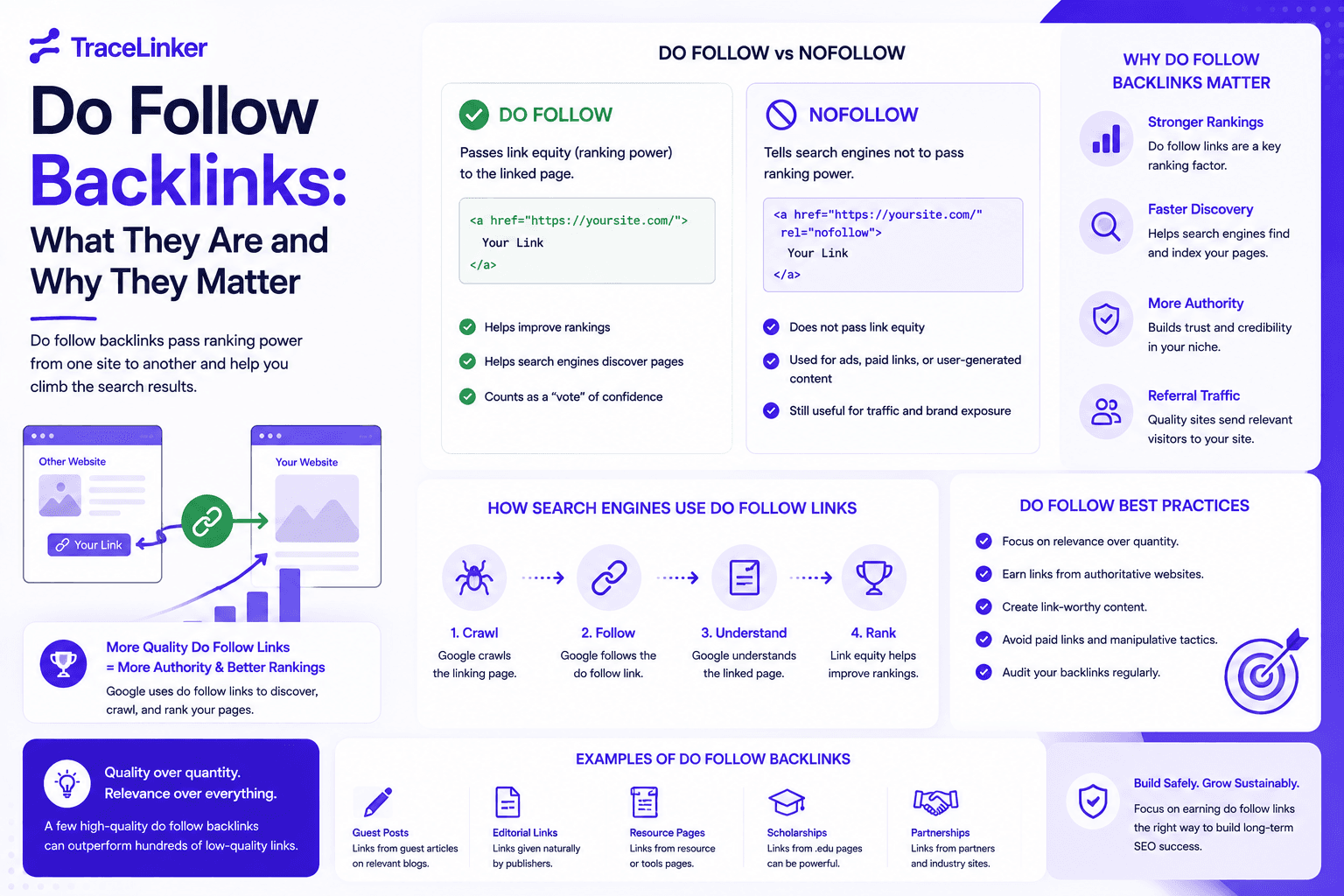


Do Follow Backlinks: What They Are and Why They Matter
Backlinks remain one of the strongest signals search engines use to decide which pages deserve to rank. But not every backlink carries the same weight. A do follow backlink can pass ranking power from one site to another, while a nofollow link tells search engines to treat the connection differently. If you are building or auditing a link profile, understanding this distinction is essential.
At TraceLinker, we help SEO teams monitor, score, and act on backlinks. In this guide, we explain what do follow backlinks are, how they differ from nofollow links, why they matter, and how to build them without putting your site at risk.
What Is a Do Follow Backlink?
A do follow backlink is a standard hyperlink that passes authority—often called "link equity" or "link juice"—from the referring site to the destination site. When a search engine crawler discovers a do follow link, it follows the link, discovers the target page, and factors the connection into its ranking calculations.
By default, every HTML link is do follow unless a rel attribute changes it. A simple do follow link looks like this:
<a href="https://example.com">Example website</a>
There is no rel="nofollow", rel="sponsored", or rel="ugc" added. That means search engines will treat it as a natural editorial vote and pass authority to the destination.
This is different from a nofollow link, which looks like:
<a href="https://example.com" rel="nofollow">Example website</a>
Google introduced the nofollow attribute in 2005 to fight comment spam. Today, nofollow is joined by sponsored and ugc as ways to qualify outbound links. The key point: a do follow link is the default state that allows authority to flow, while other attributes add qualifiers that limit or change that flow.
How Do Follow Links Work in Practice
Search engines use links to discover pages and to understand relationships between them. When a trusted site links to your page with a do follow link, it is essentially vouching for your content. Google and other search engines interpret that vote as a signal that your page is credible and relevant.
Several factors determine how much value a do follow backlink delivers:
- Authority of the referring domain. A link from a well-known publication passes more value than a link from a brand-new blog.
- Relevance of the linking page. A link from a page about SEO to another SEO resource is more meaningful than a link from an unrelated niche.
- Anchor text. Descriptive, varied anchor text provides context. Over-optimized exact-match anchors can look manipulative.
- Placement. A link inside the main body of an article usually carries more weight than a link in a footer or sidebar.
- Number of outbound links. A page that links to hundreds of other sites dilutes the value each link passes.
This is why a small number of high-quality do follow backlinks can outperform hundreds of low-quality links.
Do Follow vs. No Follow: The Core Difference
The main difference is whether search engines are encouraged to pass ranking authority through the link.
| Feature | Do Follow | No Follow |
|---|---|---|
| Default behavior | Yes, unless changed | Requires rel attribute |
| Passes link equity | Yes | Generally no, or treated as a hint |
| Crawl signal | Follow the link | Usually not followed |
| Use case | Editorial recommendations, citations | Untrusted content, ads, user-generated comments |
| SEO impact | Direct ranking influence | Indirect benefits like traffic and brand visibility |
Google has stated that nofollow is now treated as a hint rather than a strict directive. That means a nofollow link may still pass some value in some cases, but it is not the same as a do follow link. For link-building campaigns, the goal is still to earn do follow links from authoritative, relevant sites.
Why Do Follow Backlinks Matter for SEO
Do follow backlinks influence SEO in three important ways.
1. They Build Authority
Search engines use links as a proxy for trust. When reputable sites link to you, your domain and page authority grow. This is the foundation of how PageRank-style algorithms work, and it remains central to ranking today.
2. They Improve Discoverability
Search engine crawlers follow links to find new pages. A do follow link from an established site helps Google discover and index your content faster, especially for newer domains that do not yet have strong crawl schedules.
3. They Drive Referral Traffic
A good backlink is not just an SEO signal; it is also a path for real users to reach your site. When the link comes from a relevant page, those visitors are more likely to engage, convert, and return.
A healthy backlink profile contains a mix of link types, but do follow links are the primary currency for building search authority. If you are auditing your backlinks, you can use TraceLinker’s free backlink checker to see which links point to your domain and how they may be influencing your profile.
How to Check if a Backlink Is Do Follow
There are several ways to verify whether a link is do follow.
Inspect the HTML
Right-click the link, select Inspect, and look at the anchor tag. If you do not see rel="nofollow", rel="sponsored", or rel="ugc", the link is do follow.
Use a Browser Extension
Tools like MozBar, SEOquake, or Ahrefs SEO Toolbar can highlight nofollow links on a page. This is useful when reviewing competitor backlinks or checking your own outreach placements.
Run a Backlink Audit
For large-scale analysis, export your backlink data from Google Search Console or a CSV from a third-party tool and examine the link attributes. TraceLinker’s backlink CSV analyzer can help you classify links and spot which ones are likely passing equity. Pair it with the anchor text analyzer to review whether your anchor text distribution looks natural.
How to Earn Do Follow Backlinks
Earning do follow backlinks requires consistent, ethical effort. Here are approaches that work without violating search engine guidelines.
Create Link-Worthy Content
Original research, data studies, calculators, and in-depth guides attract natural links. The best backlink strategy starts with content that genuinely deserves to be referenced.
Guest Blogging
Writing valuable content for reputable sites in your niche can earn a do follow link in the author bio or body of the article. Focus on sites with real audiences and editorial standards, not networks built only for links. Our guide on guest blogging outreach covers how to find the right sites and pitch them effectively.
Digital PR and Original Research
Journalists and bloggers need sources. By publishing unique data, surveys, or expert commentary, you increase the chance of being cited with a do follow link.
Reclaim Unlinked Mentions
If a site mentions your brand but does not link, reach out and ask them to add a link. This is a low-effort way to earn do follow backlinks because the site already knows you.
Build Real Relationships
Networking with journalists, podcasters, and industry publications leads to natural linking opportunities over time. Relationships produce better links than transactional link schemes.
Fix Broken Links
Find broken links on relevant sites, then suggest your content as a replacement. This helps the site owner and earns you a do follow link at the same time. Learn more in our guide on how to find broken links on a website.
Common Myths About Do Follow Backlinks
Myth: Only do follow links matter.
No follow links still have value. They can drive traffic, build brand awareness, and contribute to a natural-looking link profile. Google also treats nofollow as a hint, so some value may still pass.
Myth: More do follow links always equal better rankings.
Quality matters more than quantity. A handful of links from authoritative, relevant sites usually outperforms hundreds of low-quality links from unrelated directories or PBNs. If you suspect toxic links, use our disavow file generator to prepare a Google-ready disavow file.
Myth: All internal links should be do follow.
Internal links should almost always be do follow. You generally only use nofollow on internal links when you want to prevent crawling of pages like login screens, checkout pages, or faceted search URLs. There is no benefit to nofollowing your own important pages.
Myth: Dofollow links appear overnight.
Even after you earn a high-quality link, it can take days or weeks for search engines to crawl and process it. Google typically recognizes new links within a few days, but ranking impact builds over time.
When to Use Nofollow or Sponsored Links
Not every link should be do follow. Google expects you to qualify links in these situations:
- Paid links or advertisements: Use
rel="sponsored". - User-generated content: Use
rel="ugc"for links in comments, forums, or reviews. - Untrusted or low-quality sources: Use
rel="nofollow"when you do not want to endorse the destination.
Properly qualifying your outbound links protects your site’s reputation and keeps your link profile aligned with Google’s guidelines. If you need to clean up problematic inbound links, our guide on how to disavow backlinks walks through the process step by step.
How TraceLinker Helps You Manage Do Follow Backlinks
TraceLinker is built specifically for backlink management. Whether you are trying to earn more do follow links or audit the ones you already have, the platform gives you a clear workflow.
- AI backlink scoring: Every link gets a transparent 1–100 score with a rationale and action items, so you know which do follow links are helping and which are risky.
- Google Search Console and CSV imports: Pull in backlinks from GSC or CSV exports from tools like Ahrefs and Semrush for unified analysis.
- Toxic link detection: Identify PBNs, spam, and suspicious context, then export a Google-ready disavow.txt file.
- Competitor gap analysis: Upload competitor CSVs to see where their do follow links come from and generate outreach pitches.
- Reclaim and outreach emails: AI drafts emails with pre-extracted contact data, so you can turn unlinked mentions or lost links into do follow backlinks faster.
- Monitoring and alerts: Track when links change, go dead, or switch from do follow to nofollow, so you can respond before rankings drift.
Understanding do follow backlinks is only the first step. The real advantage comes from monitoring them continuously and acting on the insights. Start with a free audit using our free backlink checker, then analyze your CSV data with the backlink CSV analyzer to see how much of your profile is actually passing equity.
Conclusion
Do follow backlinks are the default links that pass authority between websites. They help search engines discover content, measure trust, and rank pages. While nofollow, sponsored, and ugc links have their place, do follow links remain the most valuable type of backlink for SEO.
The best way to earn them is to create content worth referencing, build genuine industry relationships, and maintain a clean, ethical link profile. Tools like TraceLinker make it easier to track which links are do follow, identify toxic ones, and recover lost authority over time.
If you are ready to take control of your backlinks, run your profile through TraceLinker and turn your link data into a clear action plan.