
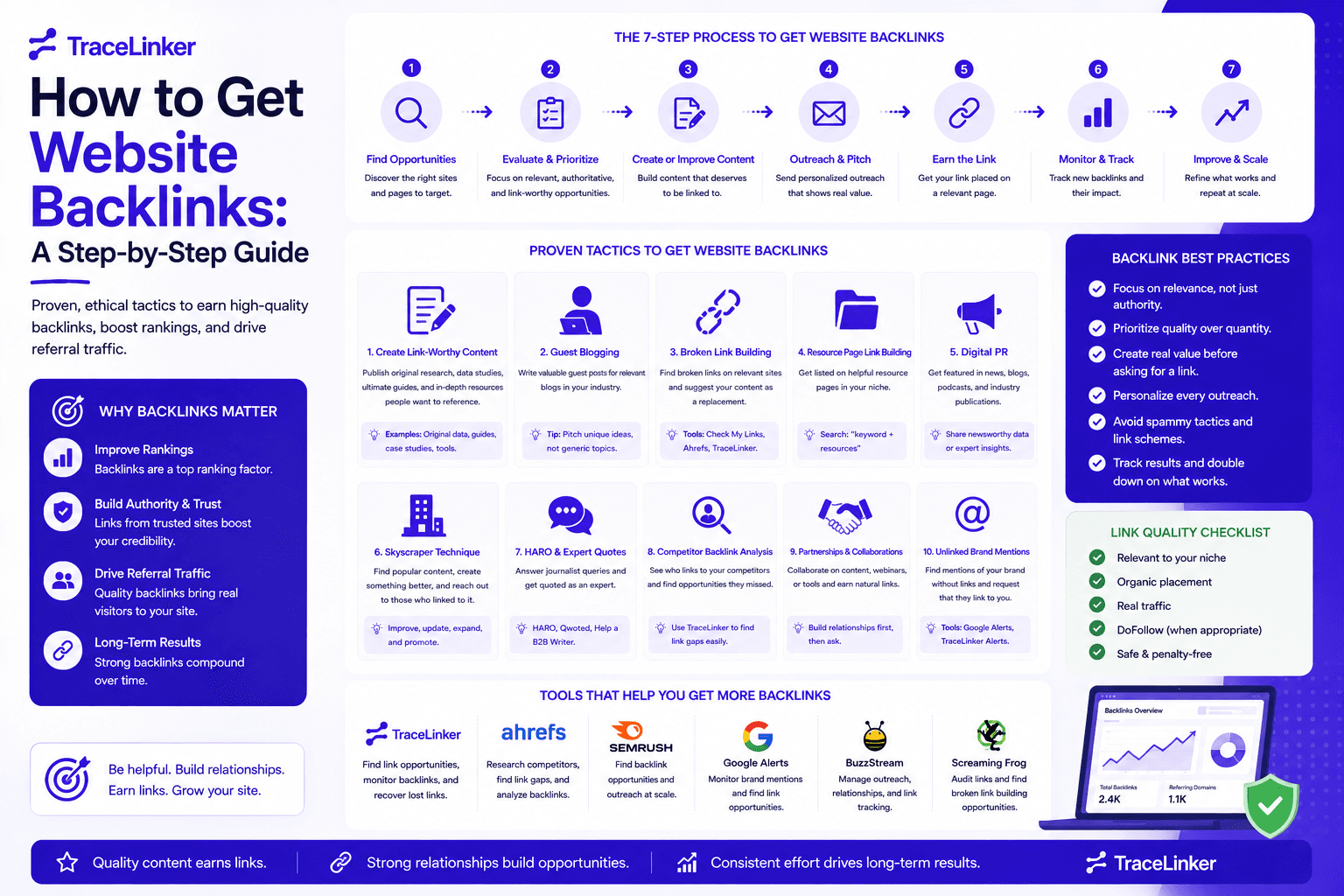


How to Get Website Backlinks: A Step-by-Step Guide
Getting backlinks is one of the hardest parts of SEO, but it is also one of the most rewarding. A single link from a trusted, relevant site can boost your authority, improve rankings, and send qualified traffic to your pages. The challenge is knowing which tactics work and how to execute them without wasting time or risking a penalty.
At TraceLinker, we help SEO teams find, monitor, and act on backlink opportunities. This guide explains how to get website backlinks through proven, ethical tactics that you can start using today.
Why Backlinks Still Matter
Search engines use backlinks as a signal of trust and authority. When a credible site links to your page, it is essentially vouching for your content. That vote helps search engines decide which pages deserve to rank.
Backlinks also matter beyond traditional rankings. In an AI-driven search landscape, consistent brand mentions, co-citations, and references from trusted sources help large language models associate your brand with topics in your niche. High-quality backlinks remain one of the best ways to build those signals.
Not all links are equal, though. The links that move the needle come from relevant, authoritative sites and appear in contexts that make sense to readers. A scattershot approach of low-quality directory submissions or paid link schemes will do more harm than good.
The Four Ways to Get Backlinks
Every link building tactic falls into one of four categories:
- Add links. Manually place links on sites you control or can access, such as social profiles, directories, or forums. These links are easy to get but carry little SEO value.
- Earn links. Create content so valuable that people link to it naturally without being asked.
- Ask for links. Reach out to site owners and request a link because you have something worth referencing.
- Buy links. Pay for placement. This is risky and violates Google’s guidelines.
The best strategies focus on earning and asking for links. Adding a few foundational links is fine, but buying links should be avoided. The rest of this guide focuses on the tactics that actually work.
Tactic 1: Turn Unlinked Brand Mentions Into Links
An unlinked brand mention is when a website mentions your company or product but does not link to you. These are the fastest backlinks to earn because the site already knows you exist.
To find them, search Google for "Your Brand Name" -site:yourdomain.com. You can also use brand monitoring tools that track mentions across the web. When you find a positive mention, send a short, polite email asking the author to add a link to the relevant page on your site.
This tactic works best when you offer a specific URL and explain why the link helps readers. If the surrounding text is vague, you can also suggest a clearer description of what your brand does, which strengthens the context for both users and search engines.
Tactic 2: Reclaim Broken Backlinks
Over time, pages move, URLs change, and links break. A broken backlink is a link that points to a 404 page on your site. You are losing the value that link was passing.
Find broken backlinks by running a backlink audit or by using a tool that checks the status of pages that link to you. When you find a broken link, identify the right replacement page on your site, then email the site owner asking them to update the link.
This is a helpful request because it improves the linking site’s user experience. Most site owners are happy to fix a broken link if you give them the exact new URL.
Tactic 3: Inherit Competitors' Broken Links
Broken link building is not limited to your own site. You can also find broken links on competitor sites and offer your content as a replacement.
The process is simple:
- Find a competitor page that has broken backlinks.
- Check if you have similar content, or create a replacement.
- Reach out to the sites that linked to the broken page and suggest your link as an alternative.
This works because webmasters do not want to send visitors to dead pages. If your content is a good fit, you can quickly earn a link that used to belong to a competitor.
Tactic 4: Create Linkable Assets
The best way to earn backlinks consistently is to create content that people want to reference. These are called linkable assets.
Types of linkable assets that work well:
- Original research and data studies. Unique data is one of the most cited content formats online.
- Industry surveys and benchmarks. People love quoting stats that compare their performance to peers.
- Visual assets. Charts, infographics, and diagrams are easy to embed and often come with attribution links.
- Free tools and calculators. Tools that solve a specific problem attract links and repeat visits.
- Ultimate guides and definitive resources. In-depth content that becomes the go-to reference for a topic.
The key is to make your asset genuinely useful and easy to cite. Include clear takeaways, a methods section, and downloadable summaries when relevant.
Tactic 5: Guest Posting on Relevant Sites
Guest posting remains one of the most reliable ways to earn a backlink. When you write a valuable article for another site, you can usually include a link back to your own site in the author bio or body of the article.
The key to successful guest posting is to focus on quality. Target sites that:
- Have a real, engaged audience in your niche
- Publish high-quality content
- Are not part of a low-quality link network
- Have editorial standards
Avoid writing thin content just for the link. If the article does not provide real value, it will not pass much authority and may even harm your reputation.
Our guest blogging outreach guide covers how to find the right sites, craft pitches, and scale the process without losing quality.
Tactic 6: Digital PR and Media Coverage
Digital PR is about earning coverage from journalists, bloggers, and publications. This can produce some of the most powerful backlinks available.
To succeed with digital PR, you need something newsworthy. That could be:
- Original research or survey data
- A controversial or contrarian opinion
- A unique case study
- A compelling product or company story
- A timely commentary on industry news
Build a media list of journalists and publications that cover your industry. Personalize your pitch, and make it clear why their audience would care. The best digital PR campaigns earn links, brand mentions, and social shares all at once.
Tactic 7: Resource Page Link Building
Resource pages are pages that curate helpful links around a topic. They exist to help readers find the best content, which makes them a natural place for your link.
Find resource pages by searching for queries like:
"your topic" inurl:resources"your topic" "helpful links""your topic" "best resources"
When you find a relevant page, check whether your content fills a gap. If it does, email the page owner with a short explanation of why your resource would be a useful addition.
Tactic 8: Build Free Tools
Free tools are one of the most effective link magnets. When you create something that solves a real problem, people naturally share and link to it.
For example, a keyword research tool, an SEO checker, or a calculator can attract thousands of backlinks over time. Tools also provide ongoing value, which keeps people coming back.
TraceLinker’s own free tools, such as the free backlink checker, backlink CSV analyzer, and anchor text analyzer, are designed to help users while introducing them to the platform.
Tactic 9: Respond to Journalist Requests
Platforms like HARO, Qwoted, and SourceBottle connect journalists with expert sources. By responding to relevant queries, you can earn links in articles at major publications.
The key is to respond quickly and provide a concise, useful quote. Journalists are working on deadlines, so a fast, high-quality response has a much better chance of being included.
Tactic 10: Build Strategic Partnerships
Partnerships with complementary businesses can lead to natural link opportunities. For example:
- Integration partners may list your tool on their partner page.
- Suppliers or resellers may link to your product pages.
- Customers may include your logo or testimonial on their site.
- Industry associations may list your company in a member directory.
These links are often highly relevant and authoritative because they come from real business relationships.
How to Prioritize Backlink Opportunities
Not every opportunity is worth your time. Use these criteria to prioritize:
- Relevance. The linking site covers topics related to your content.
- Authority. The site has a strong domain rating and organic traffic.
- Link quality. The page links out naturally and is not a link farm.
- Audience fit. The site’s readers would benefit from your content.
- Likelihood of success. The site is responsive and has a history of linking to similar resources.
A small number of high-quality links will almost always outperform a large number of low-quality links.
Metrics to Track
To measure your link building progress, track these metrics:
- New referring domains. The number of unique sites linking to you over time.
- New backlinks. Total links earned per month.
- Authority scores. Changes in domain rating or authority.
- Ranking movements. Improvements for target keywords.
- Referral traffic. Visits from newly acquired links.
- Link quality. The relevance and authority of linking sites.
- Outreach success rate. Replies and links per email sent.
Regular reporting helps you identify which tactics are working and where to adjust your strategy. Our guide on automate seo reporting shows how to streamline this process.
Common Mistakes to Avoid
Buying links. Paid links violate Google’s guidelines and can lead to penalties. If you need to recover from a link-based penalty, see our google penalty recovery guide.
Focusing on quantity over quality. A handful of relevant, authoritative links is worth more than hundreds of spammy links.
Over-optimized anchor text. Too many exact-match anchors look manipulative. Let publishers choose natural anchor text.
Ignoring link quality. A toxic backlink profile can hurt your rankings. Use the disavow file generator if you need to clean up harmful links.
Building links to weak content. Outreach will fail if the page behind it is not worth linking to. Invest in content first.
Neglecting broken links. Broken backlinks are easy wins. Reclaim them before chasing new opportunities.
How TraceLinker Helps You Get Website Backlinks
TraceLinker is designed to make backlink management easier at every stage.
- Backlink discovery: Import data from Google Search Console or CSV files to see all the links pointing to your site.
- AI scoring: Each link gets a 1–100 score with a transparent rationale and action items, so you know which links to keep, reclaim, or disavow.
- Competitor gap analysis: Upload competitor CSVs to find domains linking to them but not to you, then generate suggested outreach pitches.
- Toxic link detection: Identify PBNs, spam, and suspicious context before they become a problem.
- Monitoring and alerts: Get notified when links change, go dead, or switch from dofollow to nofollow.
- Outreach automation: AI drafts personalized emails using pre-extracted contact data, so you can turn unlinked mentions and lost links into new backlinks faster.
Getting backlinks is hard work, but the right tools and strategy make it manageable. Start by auditing your current profile with our free backlink checker, then use the backlink CSV analyzer to turn your data into a clear action plan.
Conclusion
Getting website backlinks is not about finding shortcuts. It is about creating value, building relationships, and earning links from sites that matter. The tactics in this guide work because they focus on what publishers and readers actually want: useful content, credible sources, and genuine connections.
Start with the quick wins. Find unlinked mentions, reclaim broken links, and fix toxic links in your profile. Then invest in long-term assets like original research, free tools, and media relationships. Over time, these efforts compound into a stronger backlink profile and better search visibility.
Use TraceLinker to track your progress, spot opportunities, and act on them before your competitors do.