


What Are PBN Links? A Guide to Private Blog Networks
Backlinks are one of the strongest signals search engines use to rank content. The idea is simple: when a real website links to your page, it is a vote of confidence. But not every backlink is earned. Some are manufactured.
A PBN link is a backlink from a private blog network, a group of websites created specifically to link to another site and manipulate search rankings. These networks try to fake the signals of popularity and authority, and they are explicitly against Google’s guidelines.
In this guide, we explain what PBN links are, how they work, why people use them, and why they are risky. We also cover how to identify PBN links, what to do if you have them, and how to build links the right way.
What Are PBN Links?
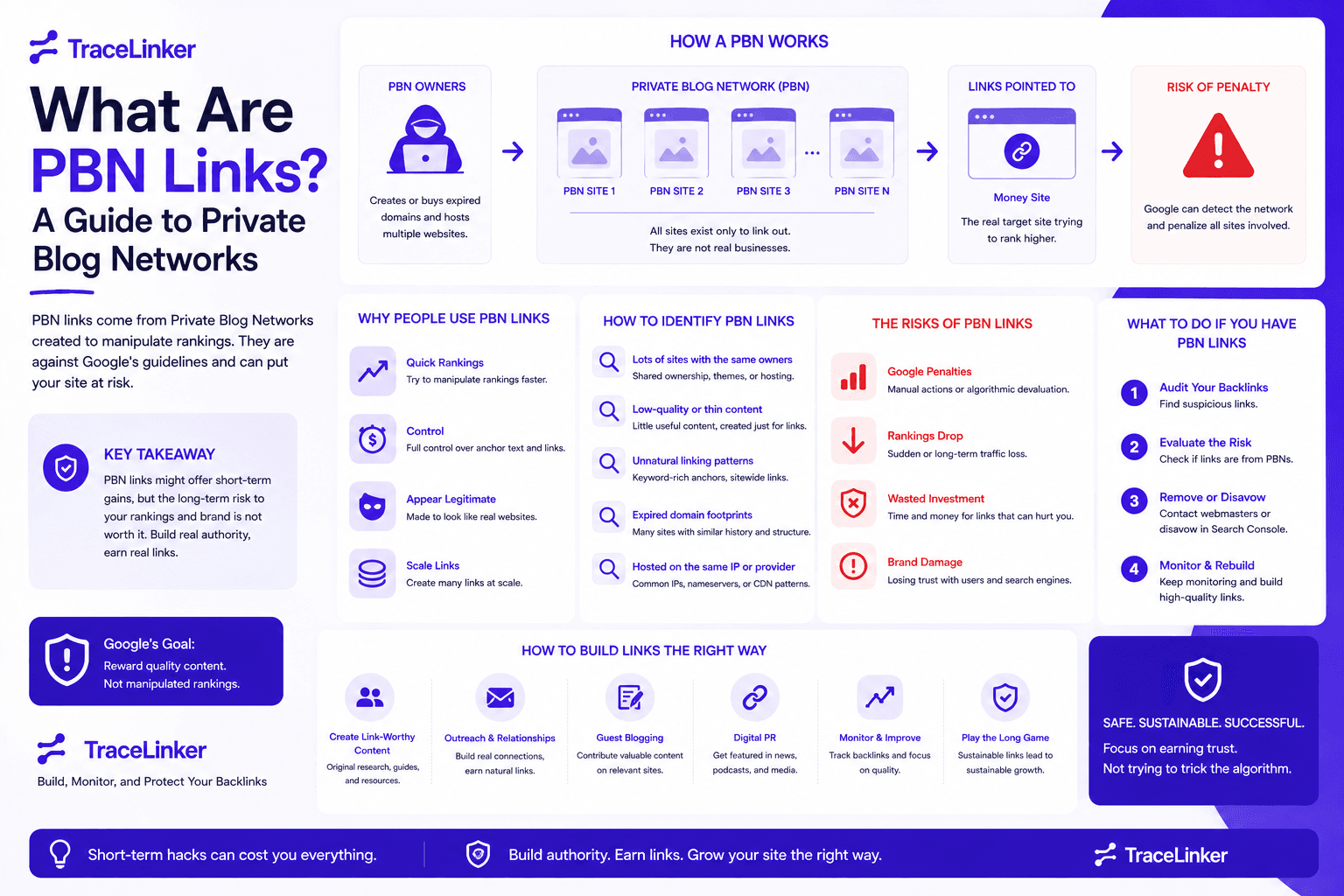
PBN stands for Private Blog Network. A PBN is a collection of websites controlled by the same person or group, built primarily to create backlinks to a target site. Those backlinks are called PBN links or PBN backlinks.
The target site is often called the "money site." The PBN sites are sometimes called "feeder sites" because their only purpose is to feed link equity to the money site.
PBNs are not real publications. They usually have little original value, thin content, and minimal traffic. Some are built on expired domains that still carry authority from the previous owner, while others are new sites filled with low-quality or AI-generated content.
The key distinction is intent. A PBN is not a network of websites that happen to link to each other. It is a network created specifically to manipulate rankings.
How Do PBNs Work?
PBNs work by exploiting the way search engines value backlinks. Google's algorithm treats links as editorial votes. A page with many high-quality backlinks is usually seen as more authoritative than a page without them.
A PBN tries to manufacture those votes artificially. The owner builds or buys multiple websites, adds content to them, and places links from those sites to the money site. Because the owner controls the entire network, they can choose:
- Which pages to link to.
- What anchor text to use.
- How many links to place.
- When to add or remove links.
This level of control is appealing to people who want fast results without doing real outreach. But it is also a clear violation of Google's guidelines.
Why People Use PBN Links
Despite the risks, some SEOs still use PBNs. The main reasons are:
Link Building Is Hard and Unpredictable
Earning backlinks from real websites takes time, effort, and creativity. Even great content does not guarantee links. Outreach campaigns can send hundreds of emails and return only a handful of placements.
PBNs promise a shortcut. Instead of earning links, you create them on demand. This makes the process feel controllable and scalable.
Control Over Anchor Text
Anchor text helps search engines understand what the linked page is about. Keyword-rich anchor text can be valuable, but it is hard to control when links come from real editors.
With a PBN, the owner can choose exact-match anchor text for every link. This is why PBNs are sometimes used to target specific keywords aggressively.
Short-Term Ranking Gains
In some low-competition niches, PBN links can produce a temporary ranking boost. This is why they continue to appear in SEO discussions and marketplaces. But the boost is usually temporary, and the risk of a penalty is high.
Why PBN Links Violate Google’s Guidelines
Google’s guidelines are clear about link schemes. Any link intended to manipulate PageRank or rankings can be considered a violation. PBNs are a textbook example of this behavior.
Google’s Webmaster Guidelines state that any link intended to manipulate rankings may be considered link spam. This includes behavior that manipulates links to your site or outgoing links from your site.
PBN links are not editorially placed. They are not earned because the content is valuable. They are placed because the network owner wants to boost a target site. That makes them artificial by definition.
Google has also released multiple link spam updates specifically designed to detect and neutralize links from low-quality networks. The December 2022 link spam update was one of the most significant.
The Risks of PBN Links
Using PBN links carries several risks. The most common outcomes are wasted money, ignored links, or penalties.
Google May Ignore the Links
Google is increasingly good at identifying unnatural links. When it detects a PBN, it may simply ignore the links rather than penalize the target site. This means the money spent on the network produces no ranking benefit.
John Mueller of Google has confirmed that Google already ignores links from sites where natural links are unlikely. This is partly to protect sites from negative SEO attacks, but it also means PBN links often have no value.
Google May Penalize Your Site
If Google believes a site is actively participating in a link scheme, it can issue a manual action. Manual actions are reviewed by human quality raters and can result in ranking drops or complete removal from search results.
A manual action for unnatural links appears in Google Search Console. Recovering requires removing or disavowing the problematic links and submitting a reconsideration request. Even after recovery, rankings may not return to their previous levels.
Algorithmic Demotions
Even without a manual action, PBN links can be devalued by algorithmic updates. A site that relied on PBN links may suddenly lose rankings when an update rolls out, with no warning and no easy recovery path.
Damage to Brand and Trust
If a site is publicly associated with manipulative link schemes, its reputation can suffer. Clients, partners, and investors may lose trust. For agencies, selling PBN links as "real" links can lead to client churn and legal disputes.
How to Identify PBN Links
Spotting PBN links is an important skill for any SEO professional. Here are the most common signs that a referring domain is part of a PBN.
Low-Quality Content
PBN sites often publish thin, generic, or AI-generated content. The articles may be short, poorly written, and packed with unrelated outbound links. There is rarely a clear editorial voice or original research.
Little or No Organic Traffic
A healthy website usually has some organic traffic from search. PBN sites often have almost none. You can check estimated organic traffic in tools like Ahrefs, Semrush, or TraceLinker.
Suspicious Outbound Links
PBN sites frequently link to many unrelated money sites in different niches. If a supposed "blog about gardening" links to payday loan sites, casino sites, and software companies, it is likely part of a network.
Exact-Match or Manipulative Anchor Text
PBN links often use keyword-rich anchor text that looks unnatural. A real editor might use branded text, a URL, or a generic phrase like "click here." A PBN owner might use exact-match anchors like "best protein powder" or "cheap SEO services."
Missing About or Contact Pages
Legitimate websites usually have an about page, contact information, and author bios. PBN sites often lack these details or use fake identities.
Shared Infrastructure
Cheaper PBNs often share hosting, IP addresses, or domain registrars. Checking referring IPs and subnets can reveal networks that look independent but are actually connected.
Sudden Traffic Spikes
If a domain suddenly gains traffic or backlinks without a clear reason, it may be an expired domain that was repurposed for a PBN. Old authority plus new thin content is a common PBN pattern.
If you notice these patterns in your backlink profile, it is worth investigating further. TraceLinker's AI backlink scoring flags suspicious patterns and gives you a clear rationale for each link it identifies as risky.
What to Do If You Have PBN Links
If you discover PBN links pointing to your site, you have a few options. The right approach depends on whether you built the links intentionally or they appeared without your knowledge.
Try to Remove the Links
For links you are genuinely concerned about, contact the site owner and ask for removal. This often does not work with PBNs because the owners are not responsive, but it is worth trying before disavowing.
Disavow the Links
Google's Disavow Tool allows you to upload a file telling Google to ignore specific links or domains. This is the standard way to deal with PBN links you cannot remove.
You should disavow carefully. Disavowing good links can hurt your rankings. Only disavow if:
- You have received a manual action for unnatural links.
- You are certain the links are from a PBN or other low-quality source.
- You want to futureproof your site against potential penalties.
TraceLinker’s disavow file generator creates a correctly formatted disavow.txt file that you can upload directly to Google Search Console. Our guide on how to disavow backlinks walks through the process step by step.
Monitor Your Backlink Profile Regularly
PBN links can appear over time, especially if you work with third-party link builders or if someone targets you with negative SEO. Regular monitoring helps you catch them early.
TraceLinker tracks your backlinks continuously, alerts you when new suspicious links appear, and monitors changes to existing links. This makes it easier to maintain a clean profile without constant manual audits.
How to Build Links Without PBNs
The safest and most sustainable way to build backlinks is to earn them. This means creating content worth linking to and reaching out to people who would genuinely benefit from sharing it.
Create Link-Worthy Content
Original research, data studies, tools, and comprehensive guides attract natural links. When your content is the best resource on a topic, other sites will reference it without being asked.
Do Real Outreach
Email outreach, digital PR, and guest posting on reputable sites can earn high-quality backlinks. These links take more effort than PBN links, but they are also safer and more durable. Learn more in our guest blogging outreach guide.
Fix Broken Links
Find broken links on relevant sites and suggest your content as a replacement. This helps the site owner and earns you a legitimate backlink. Our guide on find broken links on a website explains how to do this at scale.
Reclaim Unlinked Mentions
If a site mentions your brand but does not link, reach out and ask them to add the link. This is a low-effort way to earn editorial backlinks because the site already knows you.
Build Relationships
Networking with journalists, bloggers, and industry publications leads to natural linking opportunities over time. Relationships produce better links than any network you can buy.
For a complete strategy, read our link building strategy guide and how to get website backlinks.
PBN Links vs. Legitimate Website Networks
Not every network of related websites is a PBN. Large media companies, publishers, and businesses often own multiple sites that naturally link to each other.
The difference is intent. A legitimate network exists to serve real audiences. Links between sites are natural, relevant, and editorially justified. A PBN exists primarily to pass link equity to a target site, with little or no genuine audience value.
If you own multiple properties, cross-linking is fine as long as it is natural and useful to users. If the links are there only to manipulate rankings, you may be crossing into PBN territory.
Common Myths About PBN Links
There are several myths that keep PBNs alive in SEO conversations. Here is the truth behind a few of them.
Myth: PBN links never work.
They can produce short-term gains in some cases, especially in low-competition niches or when the network is carefully managed. But the gains are usually temporary and the risk is high.
Myth: Google can easily catch every PBN.
Google has gotten much better at detecting PBNs, but some networks hide their footprints well. However, hiding from Google does not make the links ethical or safe. The search engine is constantly improving.
Myth: You cannot be penalized for links you did not build.
Google is generally good at distinguishing negative SEO from deliberate manipulation. Most spammy links are simply ignored. But if you have a large number of unnatural links, especially from a link scheme you paid for, a penalty is possible.
Myth: Disavowing always fixes the problem.
Disavowing helps, but it is not a guaranteed fix. It also does not remove the links themselves. Recovery from a manual action requires a clean backlink profile and a reconsideration request.
How TraceLinker Helps You Detect and Handle PBN Links
TraceLinker is built to help SEO teams identify, score, and act on risky backlinks. PBN detection is one of its core use cases.
- AI backlink scoring: Every link gets a transparent 1–100 score with a rationale and action items, so you can quickly identify PBN-like links.
- Toxic link detection: The AI flags patterns associated with PBNs, spam, and suspicious context, including low-quality content, shared infrastructure, and unnatural anchor text.
- Google Search Console and CSV imports: Pull in backlinks from GSC or CSV exports from Ahrefs and Semrush for unified analysis.
- Disavow file generation: Export a Google-ready disavow.txt file with one click, so you can clean up PBN links efficiently.
- Monitoring and alerts: Track when new suspicious links appear and when existing links change, go dead, or switch from dofollow to nofollow.
- Competitor gap analysis: Upload competitor CSVs to see whether their rankings are supported by PBN links or legitimate links.
Understanding PBN links is only the first step. The real advantage comes from continuously monitoring your backlink profile and removing risky links before they cause harm. Start with a free audit using our free backlink checker, then analyze your CSV data with the backlink CSV analyzer.
Conclusion
PBN links are backlinks from private blog networks created specifically to manipulate search rankings. They offer short-term control but carry serious long-term risks, including wasted budgets, ignored links, manual penalties, and algorithmic demotions.
Google considers PBNs a link scheme and has become increasingly effective at detecting them. For most websites, the risk of using PBNs far outweighs any potential benefit. The better approach is to build a clean, ethical backlink profile through content creation, real outreach, and relationship building.
If you already have PBN links, take action. Identify them, disavow them if necessary, and put a monitoring system in place so they do not return. Tools like TraceLinker make this process faster, more transparent, and less stressful.