
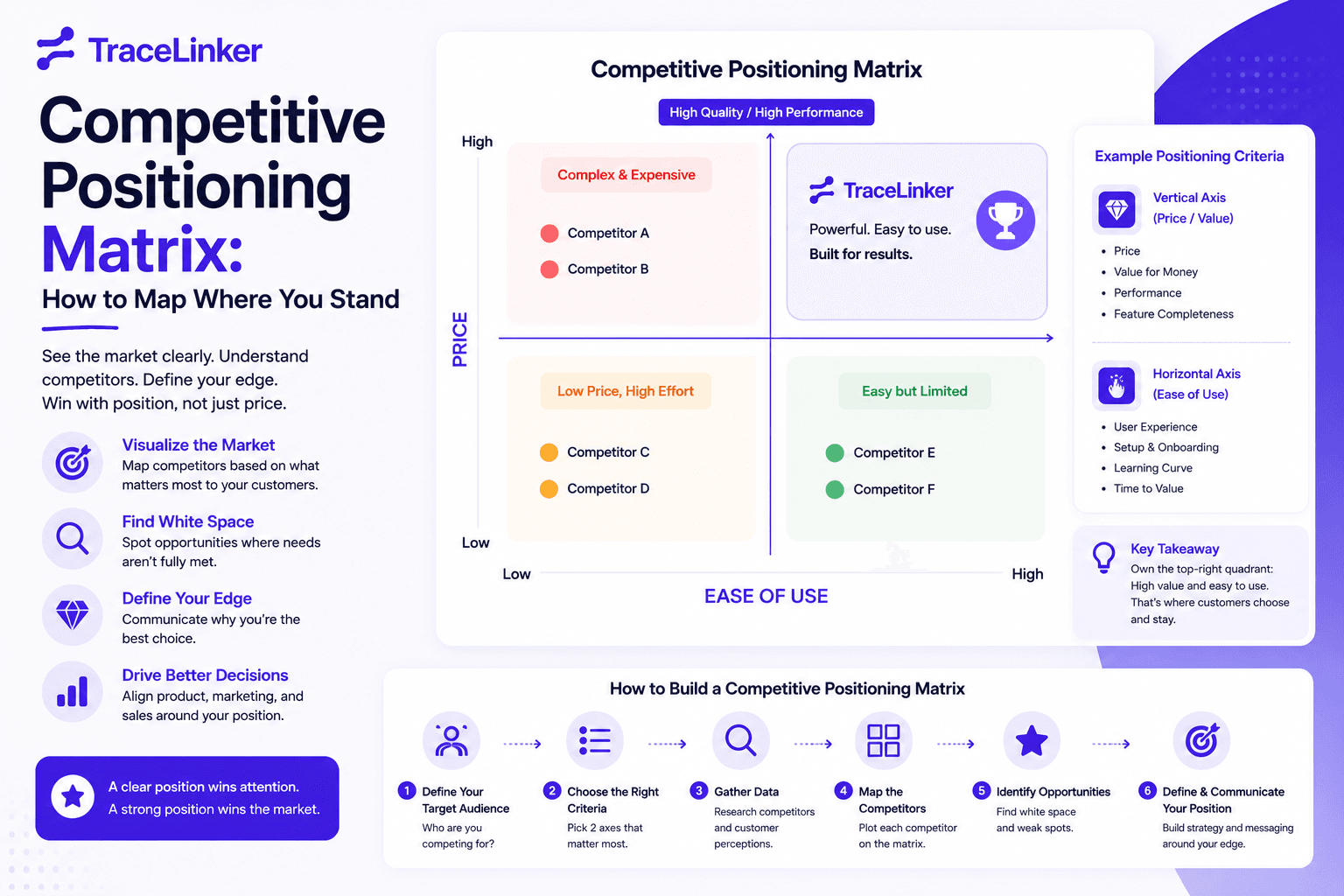


Competitive Positioning Matrix: How to Map Where You Stand
Every business competes in a crowded market. The problem is not competition itself; it is the inability to explain clearly why you are different. A competitive positioning matrix solves that. It takes the fuzzy idea of “we are better than them” and turns it into a visual map anyone can read.
This guide explains what a competitive positioning matrix is, the most useful types, and how to build one that actually informs strategy.
What is a competitive positioning matrix?
A competitive positioning matrix is a visual tool that plots your business and your competitors against two key variables. The result is a map that shows where each player sits relative to the others.
The classic version uses two axes. For example:
- Price: low to high
- Quality: basic to premium
You plot your company and competitors as points on the grid. Clusters show crowded spaces. Empty spaces show potential opportunities.
A matrix can be as simple as a 2x2 chart or as detailed as a feature comparison table. The goal is the same: make competitive positioning visible and actionable.
Why competitive positioning matrices matter
Markets move fast. New competitors appear, customer expectations shift, and yesterday’s advantage can become tomorrow’s baseline. A positioning matrix helps you:
- Spot white space where no competitor is strongly positioned.
- Identify threats from competitors moving into your space.
- Align teams around a shared view of the market.
- Sharpen messaging by clarifying what makes you different.
- Prioritize roadmap decisions based on competitive gaps.
Without a matrix, positioning discussions tend to rely on opinions. With a matrix, they rely on structure.
Common types of competitive positioning matrices
1. Price-quality matrix
The simplest and most widely used. It plots price on one axis and quality on the other.
| Quadrant | Meaning |
|---|---|
| Low price, high quality | Disruptive value player |
| High price, high quality | Premium leader |
| Low price, low quality | Budget option |
| High price, low quality | Overpriced and vulnerable |
2. Feature comparison matrix
A table that compares features across competitors. Each row is a feature, each column is a competitor. This is useful for product and sales teams.
3. Market reach matrix
Plots variables like website traffic against social media following. Good for marketing teams assessing share of voice.
4. Sales performance matrix
Plots win rate against opportunity volume. Helps sales and product marketing teams decide which competitors to prepare battle cards against.
5. Strategic positioning matrix
Uses customer-centric variables like customization, ease of use, speed, or support quality. This is often more useful than price alone because it reflects what buyers actually care about.
How to create a competitive positioning matrix
Step 1: Define your target market and customer
A matrix is meaningless if you compare the wrong competitors. Start with the segment you are targeting and the customer problem you solve. A tool that serves enterprise agencies is not competing with the same tool that serves freelance bloggers, even if they share a category.
Step 2: Choose two meaningful axes
The axes should reflect what customers care about and what differentiates competitors. Good examples:
- Ease of use vs. depth of functionality
- Speed vs. customization
- Automation vs. human control
- Niche focus vs. breadth of features
- Price vs. service level
Avoid axes that are too similar or too generic. “Quality” is vague unless you define what it means for your market.
Step 3: List competitors and score them
Pick 3–6 direct competitors. For each competitor, score them on both axes using a consistent scale, such as 1 to 5. Use public information, product reviews, customer feedback, and your own experience.
Step 4: Plot the matrix
Use a simple tool like Google Sheets, Excel, or Google Drawings. Create a scatter chart with your axes, then plot each competitor as a point. Label each point clearly.
Step 5: Analyze the map
Look for patterns:
- Where are most competitors clustered? This is a crowded space.
- Where is empty space? This could be an opportunity.
- Who is closest to you? This is your nearest rival.
- Who is moving toward you? This is a future threat.
Step 6: Turn insight into action
Use the matrix to decide what to do next. If you are in a crowded quadrant, consider differentiating on a different axis. If you are alone in a quadrant, test whether that position is attractive or simply neglected.
Example: competitive positioning matrix for backlink tools
Imagine the market for backlink management tools. Two useful axes might be transparency of scoring and depth of automation.
| Competitor | Transparency | Automation |
|---|---|---|
| Traditional SEO suite | Low — scores are black-box | Medium — scheduled reports |
| TraceLinker | High — AI rationale per link | High — alerts, re-crawls, exports |
| Manual spreadsheet | High — fully transparent | Low — everything manual |
| Enterprise link platform | Low — opaque scoring | High — enterprise automation |
On a matrix, TraceLinker would sit in the high-transparency, high-automation quadrant. That is a defensible position because it combines something customers value (understanding why a link scores a certain way) with efficiency (automation).
This kind of positioning is useful for messaging. Instead of saying “we are a backlink tool,” you can say “we are the only backlink platform that explains every score and automates the cleanup.”
Competitive positioning matrix mistakes to avoid
- Using the wrong axes: price and quality are common but not always meaningful. Pick axes that matter to your customers.
- Plotting too many competitors: a matrix with ten points is hard to read. Focus on the most relevant rivals.
- Ignoring indirect competitors: sometimes the biggest threat comes from a different category solving the same problem.
- Treating the matrix as final: markets change. Update the matrix quarterly or when a major competitor launches.
- Forgetting customer validation: your internal view of the market may not match the customer’s. Validate axes with real buyers.
Tools and templates for building a matrix
You do not need expensive software to create a positioning matrix. Useful tools include:
- Google Sheets or Excel: create scatter charts from simple tables.
- Google Drawings or Miro: free-form visual maps.
- Canva: polished charts for presentations.
- Crayon or Kompyte: competitive intelligence platforms with built-in matrix templates.
If you are building a matrix for SEO competitive analysis, combine it with backlink data. TraceLinker’s backlink CSV analyzer helps you compare competitor link profiles quantitatively, which can feed directly into a market reach or authority matrix.
How to use a positioning matrix for SEO strategy
SEO teams can use competitive positioning matrices in several ways:
- Content gaps: map competitors by content depth and search visibility to find underserved topics.
- Backlink authority: compare domain authority and link diversity to identify who is dominating authority in your niche.
- Feature coverage: compare which features competitors cover in their content and landing pages.
- Pricing vs. value: see how competitors position their free and paid offerings.
For example, if your competitors all rank well for broad SEO guides but ignore niche backlink topics, that white space is a content opportunity. You can create detailed guides on how to reduce spam score, disavow files, or anchor text analysis and capture searchers they are missing.
When to update your matrix
A competitive positioning matrix is not a one-time exercise. Update it when:
- A new competitor enters your market.
- A competitor launches a major feature or changes pricing.
- Customer needs shift, changing what axes matter.
- You are planning a product launch or repositioning.
- Your win/loss rates change against a specific competitor.
For fast-moving markets, review quarterly. For stable markets, twice a year is usually enough.
Final thoughts: a matrix is a starting point, not a strategy
A competitive positioning matrix shows you where you stand. It does not tell you what to do. The real value comes from the conversation it sparks: why are we here? Where do we want to be? What trade-offs are we willing to make?
Use the matrix to align your team, validate your differentiation, and find white space. Then back it up with execution. If your positioning hinges on transparent backlink scoring and automation, make sure your product, content, and sales materials all reinforce that story.
If you want a faster way to gather competitive backlink data for your positioning analysis, try TraceLinker. Use the free backlink checker to compare authority and link quality, and export the data into your own competitive matrix.