
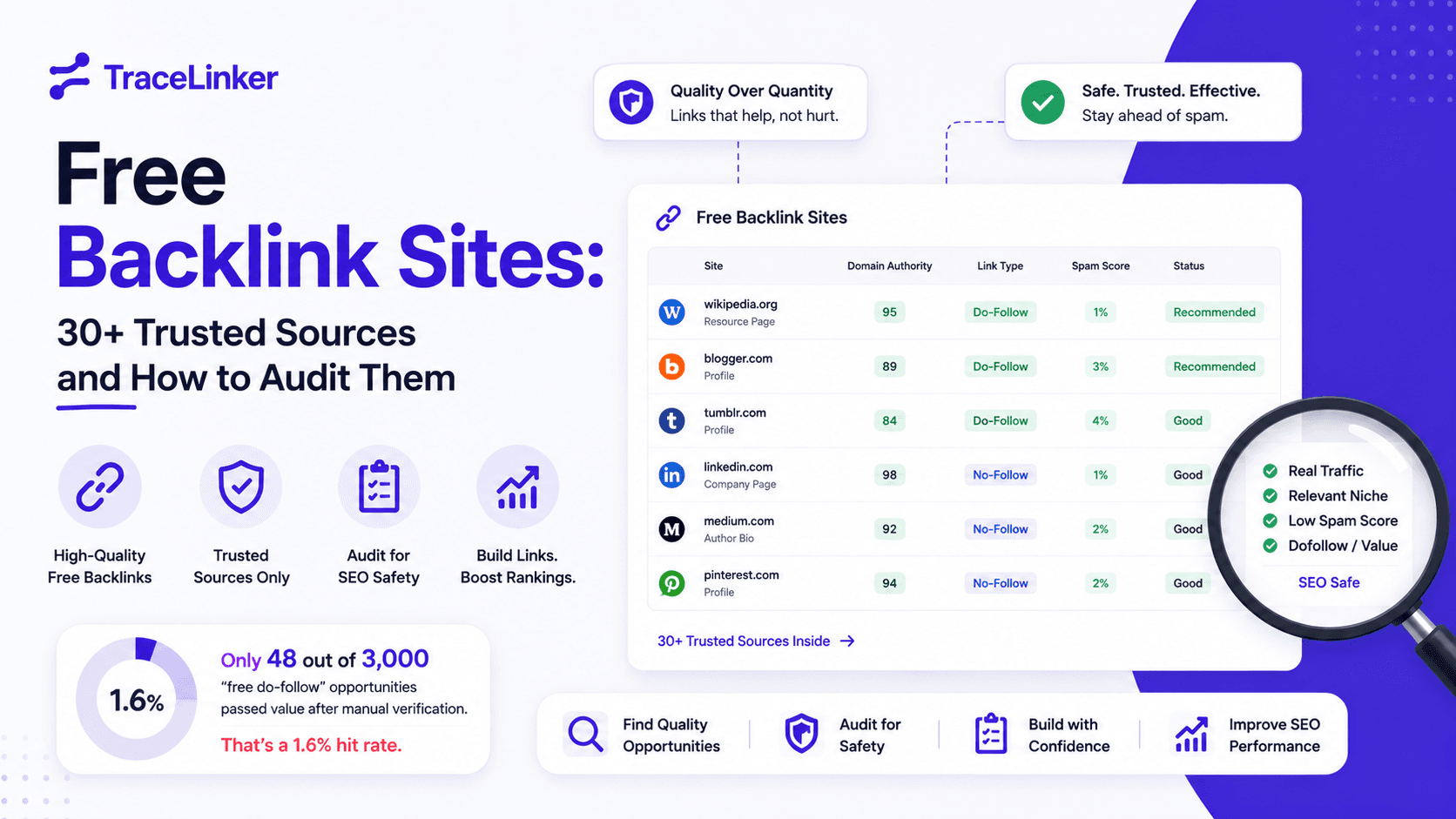


Free Backlink Sites: 30+ Trusted Sources and How to Audit Them in 2026
Finding free backlink sites is easy. Finding ones that actually help your SEO without putting you on a collision course with Google’s spam policies is the hard part.
Search for “free backlink sites” and you’ll see giant lists promising 1,000+ do-follow profile links. Most of those lists are recycled, outdated, and stuffed with expired domains, no-follow links, or outright spam. A recent independent test found that only 48 out of 3,000 “free do-follow” opportunities actually passed value after manual verification. That is a 1.6% hit rate.
This guide takes a different approach. Instead of chasing volume, we’ll focus on relevance, trust, and sustainability. Below is a curated list of 30+ real platforms where you can earn legitimate backlinks, organized by type. We’ll also show you how to build those links safely, how to spot red flags, and how to audit and monitor them with TraceLinker’s free tools.
What makes a free backlink site worth your time?
Before you start creating profiles, ask these questions:
- Relevance: Does the site make sense for your niche? A link from a marketing directory is more valuable to a SaaS company than a random classifieds site.
- Authority: Is the domain trusted? A backlink from a well-known platform like LinkedIn or G2 carries more weight than a brand-new directory.
- Indexability: Will the page linking to you actually get indexed? Empty profiles with no content rarely appear in Google.
- Link type: Is the link dofollow or nofollow? Both can send traffic and relevance, but only followed links pass ranking authority.
- Context: Is the link surrounded by useful content, or is it dumped in a footer with 500 other links?
- Editorial value: Would the link still make sense if Google did not exist? If the answer is no, it is probably not worth building.
Google’s spam policies are clear: links intended to manipulate rankings, especially low-quality directory or profile links, can be ignored or penalized. The safest approach is to treat every link as a brand-building asset first and an SEO signal second.
30+ trusted free backlink sites in 2026
We have grouped these by platform type so you can pick the ones that match your business.
Business and local directories
These are the modern replacements for old phone books. They are especially valuable for local businesses and service providers.
- Google Business Profile — Essential for local SEO. Your profile link is a trusted, branded citation.
- Bing Places — Microsoft’s local directory. Easy to claim and maintain.
- Apple Business Connect — Helps your business appear in Apple Maps and Siri.
- Yelp — Strong for service businesses and restaurants.
- Foursquare — Still used by apps and local search engines.
- Yellow Pages — A legacy brand that retains authority in some markets.
- Hotfrog — Global business directory with category targeting.
- Brownbook — Free business listing with a followed link.
- Manta — Popular for small businesses in the U.S.
- Alignable — B2B networking and local directory.
- Chamber of Commerce — If you join a local chamber, the member directory link is usually high-quality.
For local businesses, these are often the highest-impact free backlinks you can get. Make sure your Name, Address, and Phone (NAP) are consistent across every listing.
Industry and software directories
If you sell software or B2B services, these platforms put you in front of buyers who are actively comparing solutions.
- G2 — Software reviews and category listings. Strong authority and buyer intent.
- Capterra — Similar to G2, with a focus on software categories.
- GetApp — Software discovery platform with profile links.
- Software Advice — Generates leads and provides a trusted backlink.
- Clutch — Service provider reviews for agencies, developers, and consultants.
- GoodFirms — B2B service and software directory.
- Crunchbase — Company profile link ideal for startups and SaaS.
- Trustpilot — Review platform with brand credibility benefits.
- Better Business Bureau — In the U.S., a BBB listing signals trust.
The key here is to fully complete your profile and collect genuine reviews. A blank profile with only a link is unlikely to get indexed or pass value.
Social and content platforms
Social links are often nofollow, but they drive referral traffic, brand visibility, and can lead to secondary backlinks.
- LinkedIn — Publish articles, newsletters, and company page updates. The links are nofollow but highly visible to B2B audiences.
- Medium — Use the import tool to republish content with a canonical link back to your site.
- Reddit — Participate in niche communities. Self-promotion should be rare and genuinely helpful.
- Quora — Answer questions in your expertise area and link to deeper resources when relevant.
- YouTube — Add your site to the channel and video descriptions.
- Pinterest — Great for visual industries; pins can drive long-tail traffic.
- Behance — Portfolio links for creatives and agencies.
- Dribbble — Design community with profile links.
- GitHub — A must for developers and technical founders.
- Stack Overflow / Stack Exchange — Answer technical questions and link to documentation or tools.
Creative and portfolio sites
These work well if you have visual assets, case studies, or project work to showcase.
- 500px — Photography community.
- Flickr — Image hosting with profile links.
- DeviantArt — Art and creative community.
- about.me — Personal landing page.
- Morguefile — Free image community with profile links.
Upload real work, write a complete bio, and link to your homepage or a relevant landing page. The more content on the profile, the more likely it is to be indexed.
PR and podcast platforms
These are higher-effort, but the links are usually editorial and high-quality.
- HARO (Help A Reporter Out) — Respond to journalist queries and earn media mentions.
- Connectively — HARO’s successor platform for source-journalist matching.
- Qwoted — Media request platform for experts and founders.
- SourceBottle — Popular in Australia, New Zealand, and the UK.
- MatchMaker.fm — Connects podcast guests with hosts. Show notes often include a backlink.
For these, you need a genuine expert angle. One-line pitches do not work. Focus on requests where you can add real data or insight.
Resource pages and guest posts
These are not directories, but they can be the most powerful free backlinks when done right.
- Resource pages: Search for pages that collect links in your niche using operators like
intitle:"resources" your-nicheorinurl:resources your-niche. Reach out if you have a genuinely useful guide or tool. - "Write for us" guest posts: Search
"write for us" your-nicheor"guest post guidelines" your-niche. Pitch a unique, valuable article tailored to the publication’s audience.
Both of these require outreach, but the links are editorial and contextually relevant.
How to build free backlinks safely
A list of sites is useless if you build links in a way that triggers a spam filter. Follow these rules:
- Limit your velocity: Do not create 50 profiles in one day. Aim for 5–10 high-quality links per week.
- Complete every profile: Add a real photo, bio, company description, and links to social profiles. Empty profiles rarely get indexed.
- Vary your anchor text: Use branded anchors, your name, your URL, and natural phrases. Avoid exact-match keyword anchors in every profile.
- Stay relevant: Only create profiles on platforms that make sense for your business or expertise.
- Engage authentically: Answer questions, join discussions, leave reviews, and participate before promoting.
- Avoid automation: Tools that blast the same profile to hundreds of sites are the fastest way to earn a manual action.
- Track what you build: Keep a spreadsheet of URLs, login emails, dates, and whether the link is dofollow or nofollow.
How to audit and monitor your free backlinks
Once you start building, you need to know which links are helping and which are hurting. TraceLinker gives you several free tools to do this.
- Free Backlink Checker: See the links pointing to your domain and get a quick health overview.
- Backlink CSV Analyzer: Upload a CSV from Ahrefs, Semrush, or Google Search Console and analyze link quality, anchor text distribution, and toxicity patterns.
- Anchor Text Analyzer: Check if your anchor text profile looks natural or over-optimized.
- Disavow File Generator: If you find toxic links, create a Google-ready disavow.txt file in minutes.
For ongoing monitoring, TraceLinker’s paid plans track link status changes (alive, changed, dead), send email and Slack alerts, and score every link with transparent AI reasoning. You can start with the Pro plan for $9/month or explore the Agency plan for white-label reports and team workspaces.
Common mistakes to avoid
- Chasing dofollow only: A nofollow link from a relevant, high-traffic site can drive real visitors and brand awareness.
- Building links from irrelevant countries: If your business serves the U.S., a directory in India will not help much.
- Using private blog networks (PBNs): Cheap PBN links are easy to detect and can lead to penalties.
- Ignoring link status changes: A link can go from dofollow to nofollow, or the page can be removed. Monitor your backlink profile regularly.
- Forgetting to remove or disavow toxic links: Bad links accumulate over time. Run an audit quarterly and use the disavow tool when needed.
Frequently asked questions
Are free backlinks safe? Yes, when they come from relevant, trusted platforms and are built manually. Mass-created profile links from low-quality directories are not safe.
Do free backlinks still work in 2026? They can, but quality matters far more than quantity. A single link from a respected industry site is worth more than hundreds of spammy profiles.
How many free backlinks should I build per day? There is no magic number, but 5–10 manual, high-quality links per week is a safe pace for most sites. New sites should start slower.
Should I only target dofollow links? No. A natural backlink profile includes both dofollow and nofollow links. Focus on relevance, traffic, and context first.
How do I know if a free backlink is toxic? Look for signs like exact-match anchor text, links from unrelated countries, low-quality directory pages, link scheme footprints, and sudden spikes in backlinks. Use the Backlink CSV Analyzer to check for toxicity patterns.
Final thoughts
Free backlink sites are not a magic shortcut to the top of Google. They are a foundation-building tactic. When used correctly, they help establish your brand, drive referral traffic, and create a backlink profile that looks natural and trustworthy.
Start with the platforms that match your business, build them manually, and audit the results. Then use TraceLinker to monitor, score, and clean up your links as your site grows.
Ready to see what is already linking to your site? Try the free backlink checker and get a clear picture of your current profile in minutes.